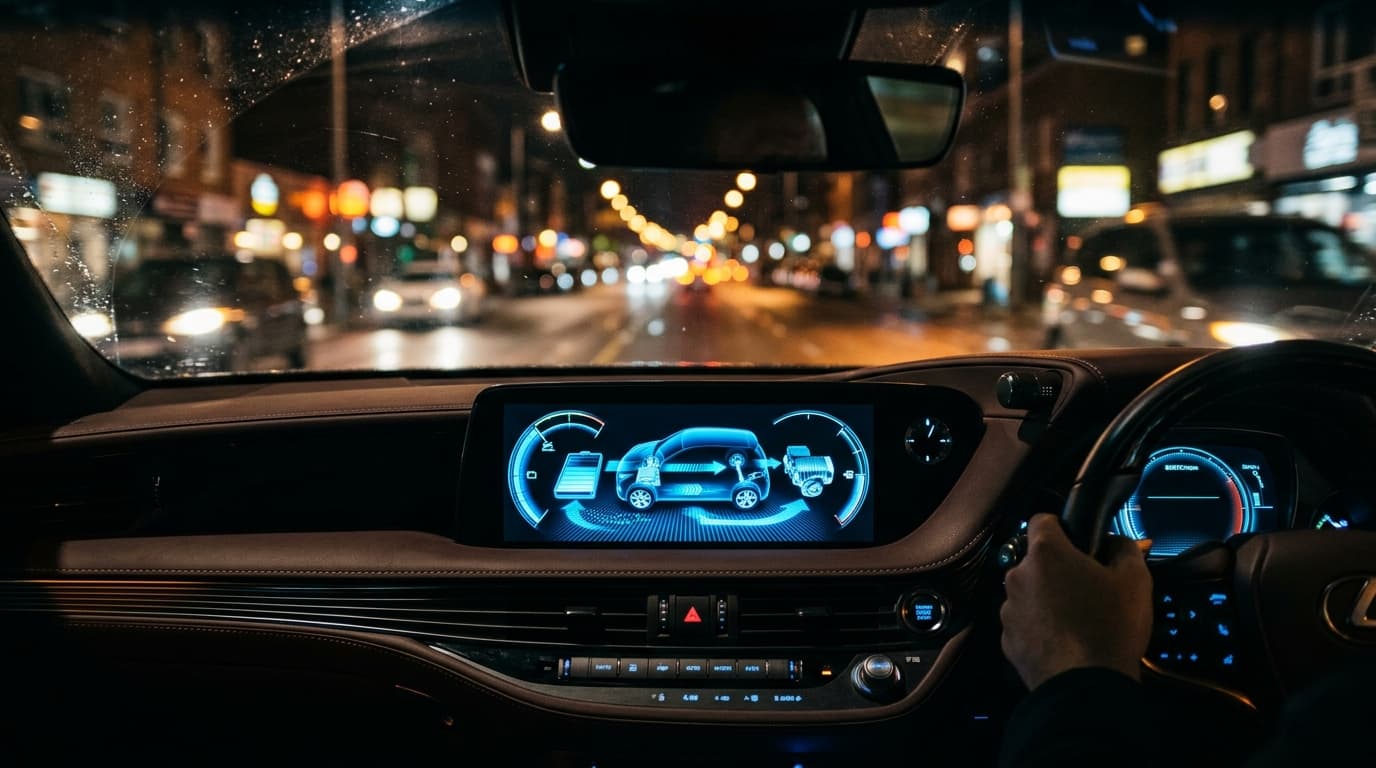
Small hybrid car: of the three a Belgian dealer will most often offer you, two genuinely drive with the engine off in town, the Toyota Yaris and the Renault Clio E-Tech. The third, the Suzuki Swift, is a mild hybrid that never does. For a city driver who covers few kilometres, the cheapest of the three costs about as much to run as the most frugal.
Three small hybrids, three ways of not plugging in
None of the three charges from a socket. That is about all they share.
The Yaris Hybrid is a series-parallel full hybrid (HEV). A planetary gearset links the 1.5 three-cylinder, a generator and the electric traction motor. The control unit blends them continuously, with no gears: that is the e-CVT, and the engine note that rises before the speed does.
The Clio E-Tech full hybrid is a full hybrid too, but Renault went a completely different way. The 1.8 four-cylinder of the Clio 6 works through a multi-mode dog-clutch gearbox, with no clutch and no synchromesh, and two electric machines handle the gear changes and low-speed traction. Traction battery: 1.4 kWh.
The Swift 1.2 is a 12 V mild hybrid (MHEV). A small lithium-ion battery feeds an integrated starter-generator, a belt, about 2 kW. It restarts the engine at the green light, helps it for a moment under acceleration, recovers a little under braking.
It never moves the car on its own.
At the dealership I saw customers discover this at their first service, convinced they had bought the same thing as their neighbour's Yaris because the tailgate said Hybrid. The badge does not tell you which of the three.
The three side by side, checked on 28 October 2026
Manufacturer data and Belgian press for prices, published road tests for fuel use. Every figure carries its date.
| Toyota Yaris Hybrid | Renault Clio E-Tech full hybrid 160 | Suzuki Swift 1.2 Hybrid | |
|---|---|---|---|
| Architecture | HEV, series-parallel, e-CVT | HEV, multi-mode dog-clutch gearbox | 12 V MHEV, starter-generator |
| Petrol engine | 1.5 three-cylinder, 1,490 cc | 1.8 four-cylinder, 1,789 cc | 1.2 three-cylinder, 1,197 cc |
| Drives with the engine off | yes, in town and when manoeuvring | yes, at low speed | no |
| Fuel use, city and suburban loop (Motor1) | 3.8 l/100 km (test published 30/09/2020) | 4.7 l/100 km (test of 06/02/2026) | 4.8 l/100 km (test of December 2024) |
| Fuel use, broader real-world driving | 4.81 l/100 km, 1,765 cars (Spritmonitor, 26/09/2026) | 5.2 l/100 km over the full test (Moniteur Automobile, 27/02/2026) | 5.16 l/100 km, one Swift CVT over 4,919 km (Spritmonitor, logs from 27/01/2025 to 26/04/2026) |
| Traction battery warranty | 5 years or 100,000 km, extendable up to 10 years in the network | 8 years or 160,000 km | no separate warranty published: general warranty of 3 years or 100,000 km |
| Fiscal horsepower | 8 CV | 10 CV | 7 CV |
| Belgian entry list price | €27,600 (December 2024 list) | €23,550 (27/02/2026) | €18,499 manual (April 2024 list) |
Two caveats before drawing any conclusion. The Yaris Motor1 measured in 2020 is the current generation, but before its 2024 facelift. And the Swift broader-use figure rests on a single car: a trend, not a measurement.
Which one really drives on electricity in town?
The Yaris, by far, going by the only large-scale data published. Toyota compiled the journeys of 117,196 British Yaris Hybrids between January and June 2023: 42% of the distance and 56% of the driving time with the petrol engine off. That figure comes from the manufacturer, using its cars' own sensors, and I read it as a ceiling rather than a Belgian average.
Renault publishes no comparable statistic for the Clio. The Motor1 test of the 145 hp Clio 5, in November 2023, noted a maximum electric range of 4.5 km before the engine restarted. The Clio 6 has a slightly larger battery, 1.4 kWh, but no measured electric share has been published yet.
The Swift: zero. Its 12 V system shuts the engine down at a standstill, like an improved stop-start, and that is all.
How much fuel do they use in real-world driving?
On the Motor1 loop, which mixes city and suburbs with the same protocol for all three cars, the order follows the architecture: Yaris 3.8, Clio 4.7, Swift 4.8 l/100 km. The gap between the Clio and the Swift, one tenth of a litre, surprised me. I expected more.
Part of the explanation is the engine. The Clio 6 carries a 1.8 and close to 1,400 kg. The Swift makes do with a 1.2 in a much lighter body. On the motorway, the Clio rises to 5.1 l/100 km according to Motor1 as well as Moniteur Automobile at 120 km/h, the Yaris to 5.3 l/100 km in the 2020 test.
In broader use, the three close up between 4.8 and 5.2 l/100 km. The Spritmonitor Yaris figure covers 1,765 cars of every generation and every kind of use, motorway included: it tells you what a Yaris does in its owners' hands, not what it does in town. The Moniteur Automobile figure for the Clio, 5.2 l/100 km, is a full Belgian road test, mixing roads and motorway.
Seven, eight or ten fiscal horsepower
In Wallonia and Brussels, the annual road tax still follows engine displacement, converted into fiscal horsepower (CV). Not the architecture. The Swift and its 1.2 stay at 7 CV, the Yaris at 8 CV, the Clio 6 and its 1.8 climb to 10 CV.
The Walloon scale valid from 1 July 2025 to 30 June 2026 gives, additional surcharges included, €243.41 for 7 CV, €300.96 for 8 CV and €415.40 for 10 CV. Moniteur Automobile points this out in its Clio test: the 1.8 penalises it against rivals with smaller engines. In Flanders, the tax on a recent car is adjusted for CO2 and Euro standard, and the calculation differs: the region-by-region detail is in the article on hybrid car registration tax in Belgium.
I added up fuel and tax for a Walloon city driver covering 8,000 km a year, at the maximum Super 95 E10 price posted for 29 October 2026, €1.988 per litre.
| For 8,000 km a year in Wallonia | Yaris Hybrid (8 CV) | Clio E-Tech 160 (10 CV) | Swift 1.2 Hybrid (7 CV) |
|---|---|---|---|
| Fuel, Motor1 city and suburban loop | €604 | €747 | €763 |
| Fuel, broader real-world driving | €765 | €827 | €821 |
| Road tax 2025-2026 | €301 | €415 | €243 |
| Total per year, Motor1 loop | €905 | €1,163 | €1,007 |
| Total per year, broader driving | €1,066 | €1,242 | €1,064 |
In the case most favourable to the Yaris, it saves €102 a year over the Swift. The entry price gap exceeds €9,000, even if that compares an automatic Yaris with a manual Swift. On low annual mileage, no full hybrid pays back its extra cost at the pump.
What traction battery warranty does each one get?
Renault covers the Clio E-Tech battery for 8 years or 160,000 km, whichever comes first, and refers to the warranty booklet for conditions. I found no obligation to service within the network there: get the Belgian dealer to confirm it in writing.
Toyota Belgium covers the hybrid battery for 5 years or 100,000 km, then extends it by one year, 15,000 km at most, after each positive check in the approved network, up to the car's tenth year. Serviced at the dealer, the Yaris ends up covered longer than the Clio. At an independent garage, it falls back to 5 years.
Suzuki shows no separate warranty for the Swift's 12 V battery: it falls under the general warranty, 3 years or 100,000 km. Since 1 January 2026, Suzuki France extends it year by year up to 10 years or 200,000 km after a network service. I found no published Belgian equivalent. Ask for it.
Once the warranty has expired, the stakes are not the same size. A Swift 12 V battery is a small part. A new Yaris traction battery fitted at a dealer cost €2,000 to €5,000 at the last check, detailed in the article on hybrid car battery cost in Belgium.
Can a hybrid enter Belgian low emission zones?
Yes, and the architecture makes no difference. Low emission zones look at fuel and Euro standard, never at MHEV, HEV or PHEV. A new Swift, Yaris or Clio, built to a recent Euro 6 standard, faces no deadline in the near future.
In Brussels, since 1 January 2026, only Euro 2 petrol and Euro 5 diesel cars are excluded, with a warning letter before the first fine. Wallonia has dropped its LEZ project. Antwerp and Ghent apply theirs. The Brussels timetable adopted in 2021 aimed to phase out petrol, hybrids included, around 2035: it has been revised since, so check your plate on the lez.brussels simulator.
My verdict, depending on your city
Three cars, three different drivers.
- You mostly drive in traffic jams and service at the dealer: the Yaris. The most frugal in town, the only one whose electric share is documented at scale, and battery cover that can run to ten years.
- You want an automatic and a battery warranty that depends on no check: the Clio E-Tech. Cheaper than the Yaris to buy, 8 years of battery cover, but 10 CV and almost a litre more per 100 km in town.
- You drive little, often short trips, and the budget decides: the Swift. A mild hybrid that is honest about what it is, the cheapest to buy and level with the Yaris on annual cost in broader use.
On the test drive, whichever car you try:
- start with a cold engine and count how long the petrol engine runs before it shuts off;
- drive round the block at 30 km/h and watch the energy-flow screen;
- ask in writing for the traction battery warranty, its mileage and its servicing conditions;
- note the fiscal horsepower and the WLTP CO2 on the certificate of conformity.
The ranking of hybrids sold in Belgium covers other models with the same criteria, and the choice method helps you put your use in the right box.
Comparator
Compare voitures hybrides side by side.
Compare now →
Frequently asked questions

Olivier a passé dix ans en atelier de concession dans le Hainaut, de 2011 à 2021, sur le poste qui reçoit les voitures dont le tableau de bord s'allume sans que personne ne comprenne pourquoi. Il a démonté des batteries de traction, mesuré des modules un par un, et expliqué à des dizaines de clients pourquoi leur consommation ne ressemblait pas à celle de la brochure. Depuis 2022 il compare les hybrides vendues en Belgique depuis l'autre côté du comptoir, relève les tarifs de remplacement en concession et les conditions de garantie de batterie constructeur par constructeur. Ce qui l'agace : le mot « autorechargeable », inventé pour vendre, qui laisse croire à un acheteur qu'il roulera à l'électricité gratuite, et les fiches techniques qui affichent une consommation mesurée batterie pleine sans jamais préciser ce qui se passe une fois qu'elle est vide.