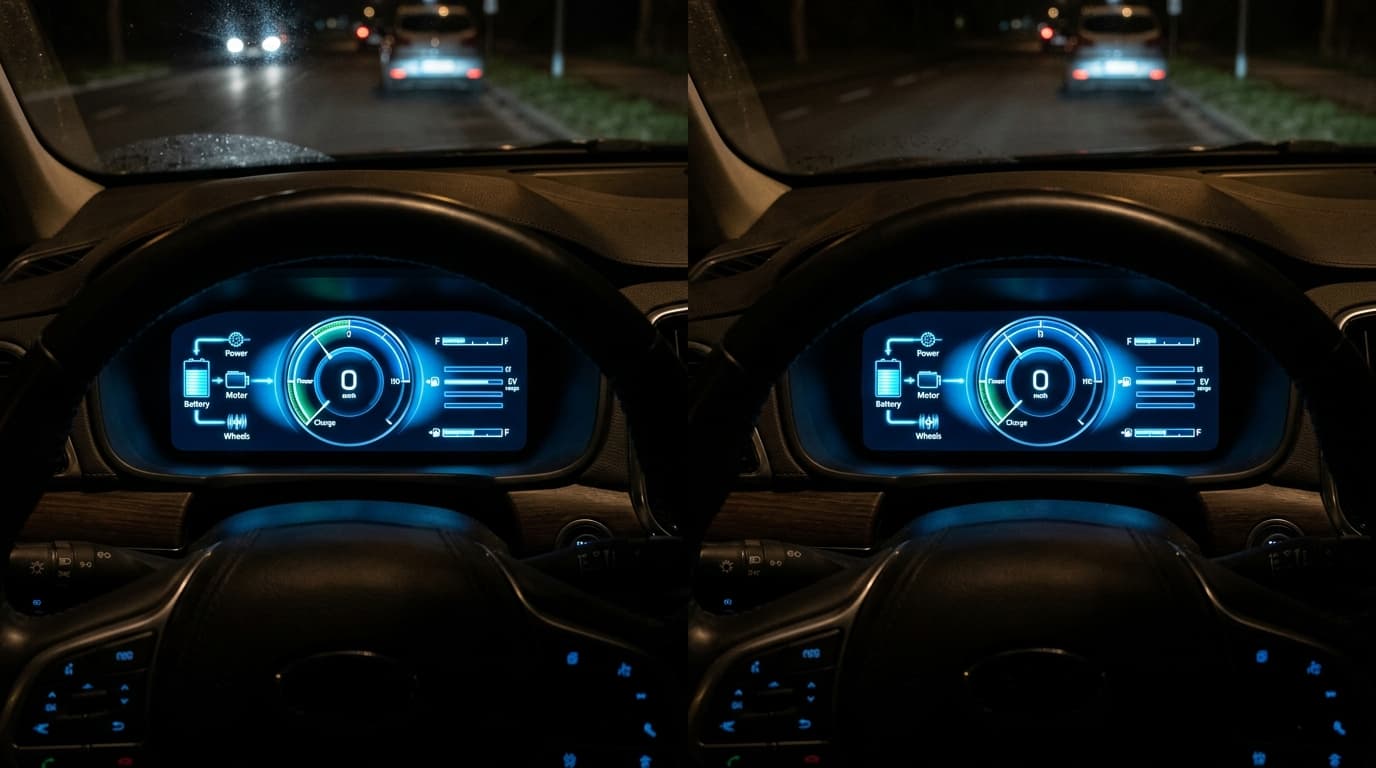
Corolla hybrid or 308 hybrid: the question hides another one, because the 308 “hybrid” comes in two versions that have almost nothing in common. Against the Corolla, a full hybrid, Peugeot fields a 48 V mild hybrid and a plug-in. With no socket at home, I take the Corolla. With a socket and under 60 km a day, the 308 plug-in.
Three cars behind two names
The badge lies by omission. On a 308 tailgate, “Hybrid 145” and “Plug-in Hybrid” look almost alike, while the second one's battery is nearly twenty times the size of the first one's. The Corolla comes in a single architecture, and it is the oldest of the three: Toyota has been selling full hybrids for more than twenty-five years.
I put everything into one table. Prices and specs come from the two brands' Belgian websites, real-world consumption from Spritmonitor, all checked on 29 September 2026.
| Toyota Corolla 1.8 Hybrid | Peugeot 308 Hybrid 145 e-DCS6 | Peugeot 308 Plug-in Hybrid 195 | |
|---|---|---|---|
| Architecture | HEV, full hybrid | MHEV, 48 V mild hybrid | PHEV, plug-in hybrid |
| Combined output | 140 hp | 145 hp | 195 hp |
| Gearbox | continuously variable automatic (e-CVT) | 6-speed dual clutch, 28 hp electric motor built in | 7-speed dual clutch |
| Traction battery | recharges while driving, never plugs in | 898 Wh gross, 432 Wh usable, under the front left seat | 17.2 kWh, plugs in |
| WLTP certified consumption | 4.3 to 4.6 l/100 km | 4.8 to 5.1 l/100 km (SW) | 1.0 to 1.4 l/100 km weighted (SW) |
| Logged consumption, Spritmonitor | 5.22 l/100 km, 1,568 cars | 5.78 l/100 km, 15 cars | 4.15 l/100 km, 44 cars, electricity not counted |
| Battery warranty | 5 years or 100,000 km, extendable to 10 years in the network | 8 years or 160,000 km (Peugeot announcement, 2023) | 8 years or 160,000 km, 70% minimum capacity |
| Belgian fiscal horsepower | 10 CV | 7 CV | 9 CV |
| Price found in Belgium | €34,970 list, €28,990 after discounts (offer valid until 30/09/2026) | €30,665 in Style trim (price shown on peugeot.be, April 2026 offer) | €41,885 as SW Allure (Belgian price list, September 2025) |
Two words of caution. The Corolla figure mixes several generations, from 122 to 196 hp, and it runs 12.7% above Toyota's claimed figure for the cars whose catalogue value is known. The 308 Hybrid 145 figure rests on fifteen drivers: I read it as a trend, not a measurement.
Which one uses the least fuel in real-world driving?
The Corolla, as long as you compare the two cars that never plug in. The logged gap is 0.56 l/100 km, roughly 84 litres of petrol over a 15,000 km year. Not a chasm. But it always points the same way, and it comes from the architecture, not from tuning.
A full hybrid like the Corolla can move the car on its electric motor alone for whole sequences: leaving a car park, queuing at the lights, rolling down from a roundabout, crawling on the Brussels ring. Peugeot's mild hybrid does the same, but with a 21 kW, 55 Nm motor housed in the gearbox and a battery storing only 432 Wh usable. It relieves the three-cylinder more than it replaces it.
And on the motorway? Peugeot wrote it itself in the technical presentation of its 48 V system, in February 2023: most of the saving is made in town and on A-roads, and motorway consumption stays unchanged compared with an equivalent petrol car. The Corolla works no miracle there either. At 120 km/h, both run mostly on petrol.
What does the 308 Hybrid 145 actually do on electricity?
It pulls away, it manoeuvres, it creeps along in a traffic jam, and it shuts its petrol engine down when you lift off, up to 145 km/h. Peugeot says its models fitted with this system drive “more than 50% of the time” on electricity in town.
Read that carefully: time, not kilometres. A car stopped at a red light with the engine off, or crawling at 8 km/h in a queue, spends a lot of time on electricity while covering very little distance, and this is exactly the kind of figure I spent my days explaining to customers who were comparing the brochure with their fuel receipts. The figure is not false. It just does not measure what the reader thinks it measures.
I never had this system on a lift. It reached Peugeot in 2023, two years after I left the workshop, and I have no hands-on hindsight on how it ages. I can read a spec sheet, though: 898 Wh gross, a 48 V lithium-ion battery, an electric motor that doubles as the main starter, and a dual-clutch gearbox that houses the inverter. It is a simpler architecture than Toyota's, and probably cheaper to build.
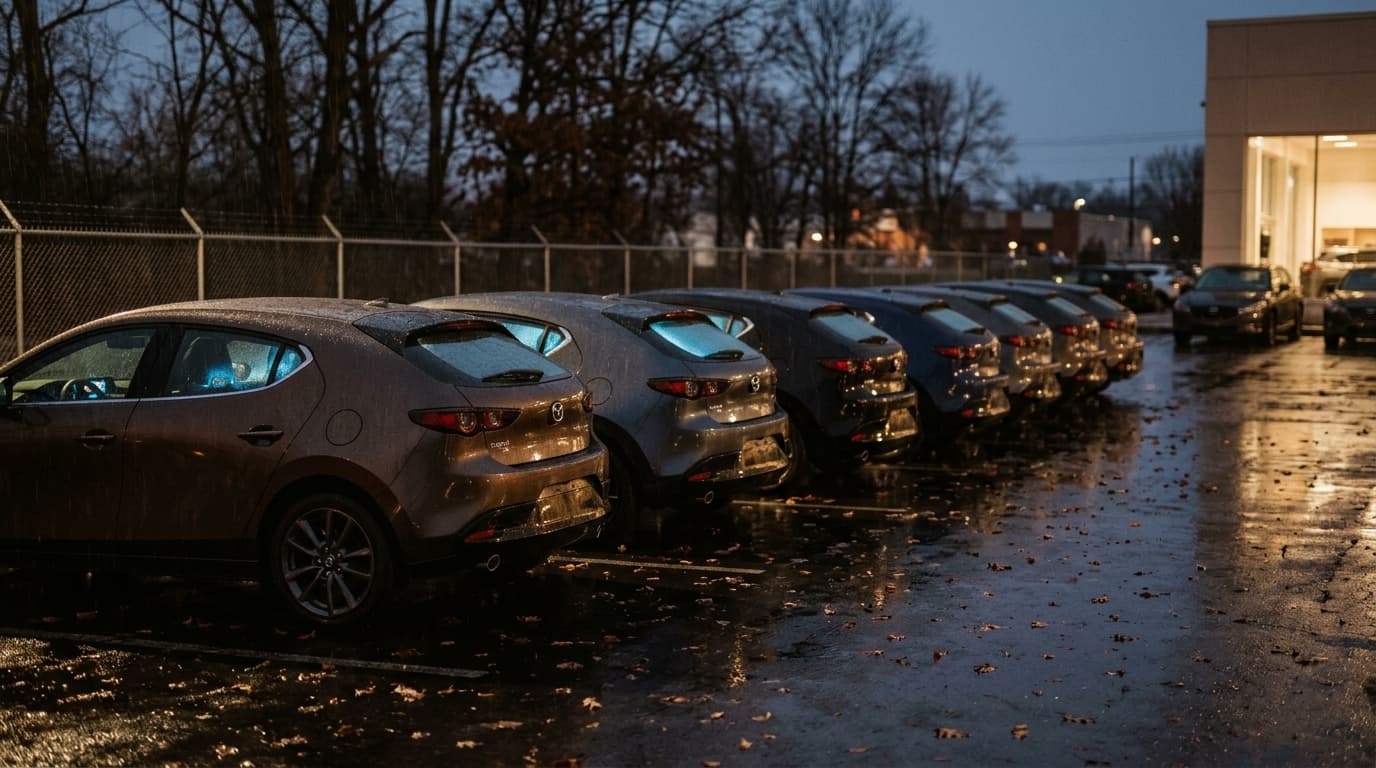
The 308 plug-in, full battery then empty battery
It is the only one of the three that can do a real home-to-work commute without a drop of petrol. On the Belgian 308 SW price list from September 2025, the 195 version claims 78 to 85 km of WLTP electric range, a 17.2 kWh battery, a 3.7 kW on-board charger as standard and 7.4 kW as an option. Full charge: 7 h 25 on a 10 A household socket, 2 h 05 on a wall box with the 7.4 kW charger.
With the battery empty, the picture changes. Peugeot does not list an empty-battery consumption for the 195 in its Belgian price list; for the previous-generation 308 plug-in 180, its German subsidiary publishes 6.2 l/100 km once the battery is drained. That is more than the Corolla and more than the Hybrid 145, with 155 kg more to haul than the latter on the SW (1,737 kg against 1,582 kg in running order).
The 44 plug-ins logged on Spritmonitor tell the same story: from 1.26 to 7.50 l/100 km. Same car. The gap is the socket.
What battery warranty does each one carry?
At Toyota Belgium, the hybrid battery is covered for 5 years or 100,000 km, and every passed test during a service in the approved Belgian or Luxembourg network extends the cover by one year, 15,000 km at most, up to the car's 10th year. At Peugeot Belgium, the traction battery of a plug-in is covered for 8 years or 160,000 km, with a guaranteed minimum capacity of 70%.
For the 48 V battery in the Hybrid 145, Peugeot announced the same term when the system was launched, 8 years or 160,000 km. The Belgian battery warranty page, however, only mentions electric and plug-in cars. Have the 48 V battery cover written on the order form: a salesperson confirming it out loud commits you to nothing.
The maths depends on you. If you service at a dealer, the Corolla can stay covered for up to ten years, two more than the 308. If you plan to use an independent garage once the manufacturer warranty ends, the Corolla drops back to 5 years, while the Peugeot in principle keeps its 8 years, subject to the service schedule. Once the warranty is over, a new Toyota hybrid battery fitted at a dealer cost between 2,000 and 5,000 euros at our last check, detailed in the article on hybrid car battery cost in Belgium.
Belgian taxes: seven, nine or ten fiscal horsepower
The most frugal of the three also carries the most fiscal horsepower. The Corolla 1.8 has 1,798 cc, which makes 10 CV on the Belgian scale; the 308 Hybrid 145 shows 7 and the plug-in 9, according to Peugeot's price list. In Wallonia and Brussels, the annual road tax is based on that fiscal horsepower: you pay the gap every year.
The registration tax has changed logic in Wallonia. Since 1 July 2025, the SPW Finances calculates it by combining power in kW, vehicle age, CO2 emissions, maximum authorised mass and energy type. In Flanders, the calculation is environmental and looks first at certified CO2: the plug-in, certified at 18 to 22 g/km on the SW, starts with an edge on paper. Run the certificate of conformity data through your region's simulator before you sign, not after.
My verdict, profile by profile
I will not pick one car for everybody, because these three do not answer the same driver. Here is how I would split them:
- You drive mostly in town and on the outskirts, with no socket at home: the Corolla. It covers the largest share of the trip on electricity of the two non-plug-ins, and its architecture has twenty years of workshop feedback behind it.
- You have a socket or a wall box, and drive under 60 km a day: the 308 plug-in, provided you plug it in every night. Otherwise you paid €7,530 more than a Hybrid 145 in the same trim (SW Allure, September 2025 price list) to carry an empty battery around.
- You want the lowest annual road tax in Wallonia or Brussels: the 308 Hybrid 145 and its 7 CV, accepting that it uses slightly more fuel than the Corolla and is not cheaper once Toyota's discounts are deducted.
- You keep your cars for more than eight years and service them at a dealer: the Corolla, for battery cover that can run up to ten years.
- You mostly drive on the motorway: none of the three justifies its hybrid premium there, and the 308 is still sold as a BlueHDi diesel.
If the difference between mild, full and plug-in hybrids is still fuzzy, start with how a hybrid car works. The ranking of hybrids sold in Belgium covers other models with the same criteria, and the choosing method helps you place your own driving in the right box.
Comparator
Compare voitures hybrides side by side.
Compare now →
Frequently asked questions

Olivier a passé dix ans en atelier de concession dans le Hainaut, de 2011 à 2021, sur le poste qui reçoit les voitures dont le tableau de bord s'allume sans que personne ne comprenne pourquoi. Il a démonté des batteries de traction, mesuré des modules un par un, et expliqué à des dizaines de clients pourquoi leur consommation ne ressemblait pas à celle de la brochure. Depuis 2022 il compare les hybrides vendues en Belgique depuis l'autre côté du comptoir, relève les tarifs de remplacement en concession et les conditions de garantie de batterie constructeur par constructeur. Ce qui l'agace : le mot « autorechargeable », inventé pour vendre, qui laisse croire à un acheteur qu'il roulera à l'électricité gratuite, et les fiches techniques qui affichent une consommation mesurée batterie pleine sans jamais préciser ce qui se passe une fois qu'elle est vide.