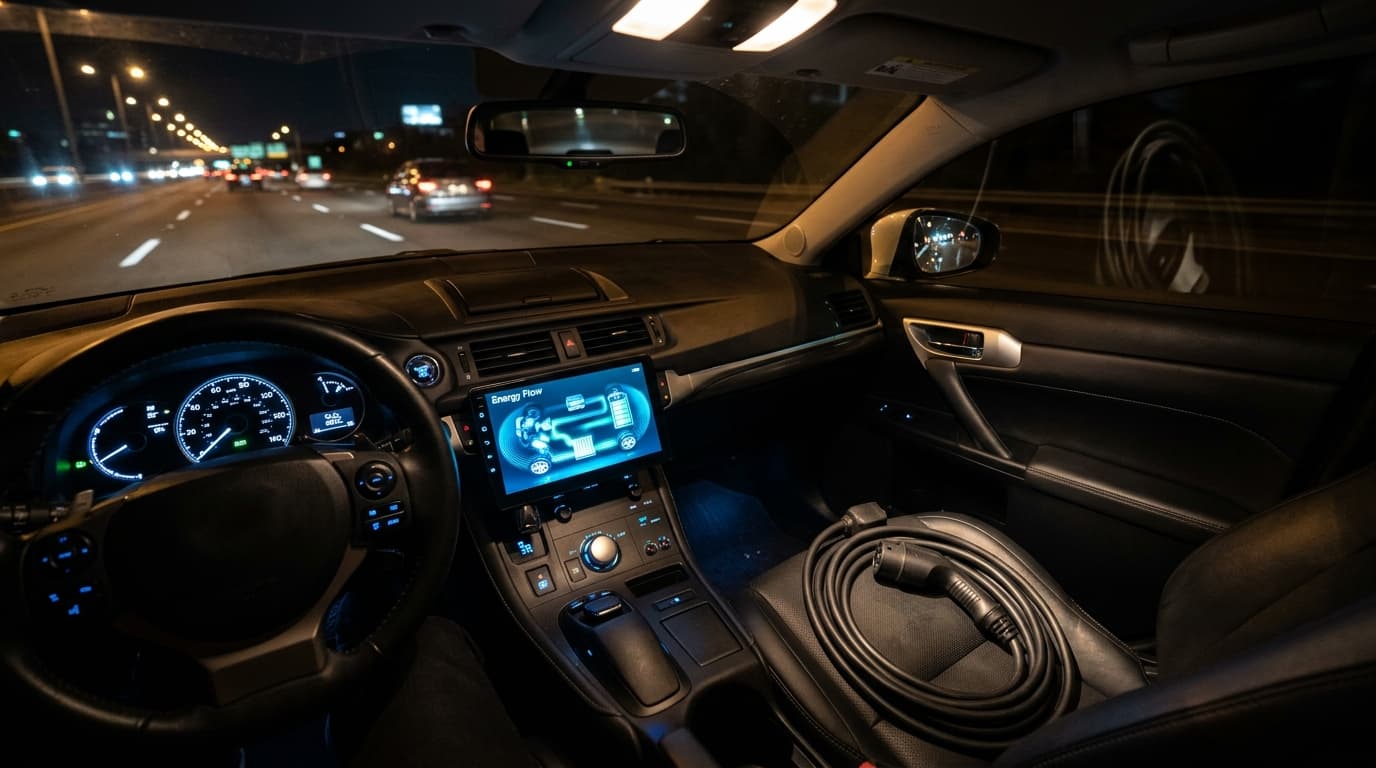
Full hybrid or plug-in hybrid: for a private Belgian driver covering 15,000 km a year, the full hybrid, almost every time. The plug-in only pays back its extra cost if it is charged every night, and even then it takes thirteen years in Flanders and seventeen in Wallonia. It still makes sense as a company car, or for short, regular trips.
One plug, a battery eight times larger, and the same engine
On paper, everything sets them apart. Under the bonnet, they are far closer than the brochure suggests.
A full hybrid (HEV) has a small traction battery that fills up through braking and the petrol engine. It pulls away on electricity, creeps through a car park or a traffic jam without petrol, then the engine takes over again. No plug. No electric kilometres in the sense you mean: a few hundred metres at a time, never a whole morning.
A plug-in hybrid (PHEV) keeps exactly that system and adds a charging socket and a battery big enough to cover an entire commute without starting the engine. With a full battery, it is a small electric car. With an empty one, it is a full hybrid carrying a hundred kilos too many.
I saw both come through the workshop. On the lift, the difference comes down to a thicker orange cable, an on-board charger and a battery case that eats into the boot floor or the fuel tank space. The rest is the same family of parts.
Head to head on a single car: the Kia Niro
To compare the two architectures without comparing two bodies, you need a model sold in both versions. The Kia Niro has been, in Belgium, with the same 1.6 GDi petrol engine. Prices come from the Moniteur Automobile list checked on 23 October 2026, real-world consumption from Spritmonitor as of 26 September 2026.
| Kia Niro Hybrid | Kia Niro Plug-in Hybrid | |
|---|---|---|
| Architecture | HEV, full hybrid | PHEV, plug-in hybrid |
| Traction battery | 1.32 kWh | 11.1 kWh gross, 111 kg |
| Rated electric range | none stated | 65 km WLTP |
| Mains charging | not possible | 3.3 kW maximum, AC |
| Consumption logged by drivers | 5.03 l/100 km | 2.87 l/100 km across 309 cars, full and empty battery mixed, electricity not counted |
| Traction battery warranty | 8 years or 160,000 km (model year 2026), 7 years or 150,000 km before | 7 years or 150,000 km, 70% capacity (model year 2025) |
| Belgian list price | €34,990 to €40,990 (model year 2026) | €41,790 to €47,690 (model year 2025) |
One caveat I have to spell out. The Belgian list now shows the plug-in Niro only as a 2025 model year, and the Niro hybrid as a 2026 model year. If you find a new plug-in, it is probably stock: negotiate accordingly. The rest of the reasoning holds for any hybrid and plug-in pair from the same range.
The plug-in's specifications come from a spec sheet based on Kia documentation: 183 hp combined, 1,594 to 1,685 kg kerb weight.

How much does an electric kilometre cost in Belgium?
Less than a petrol kilometre, but by a much smaller margin than people think. It is the figure missing from every comparison I have read, and it is the one that decides.
For electricity, I use the tariff the CREG publishes for reimbursing home charging of company cars, because it is the only official per-kWh price, region by region, updated every quarter. In the fourth quarter of 2026: 37.79 cents in Wallonia, 36.88 in Brussels, 32.25 in Flanders. For petrol, the maximum price of Super 95 E10 set on 13 October 2026: €2.105 a litre, according to L'Avenir.
That leaves the plug-in Niro's electricity use, which Kia does not publish in a usable form. I estimate it myself: 11.1 kWh for 65 km, plus about 10% lost between the socket and the battery, so roughly 19 kWh per 100 km paid at the meter. That is a summer assumption. In winter, count on more.
The result, per 100 km:
- in a Niro hybrid, 5.03 litres at €2.105, or €10.59;
- in a plug-in Niro on electricity, 19 kWh at 37.79 cents in Wallonia, or €7.18;
- the same in Brussels, €7.01;
- in Flanders, €6.13.
Each kilometre driven from the socket rather than on petrol therefore saves 3.4 cents in Wallonia, 3.6 in Brussels, 4.5 in Flanders.
No more than that.
How many years before the plug-in pays for itself?
Take the entry-level gap from the table, €6,800 between the two Niros, and 15,000 km a year. Three drivers: one who never plugs in, one who charges like the average plug-in Niro owner (about 43% electric kilometres, derived from the logs in our article on plug-in hybrid real-world fuel consumption), and one who charges every night and drives 80% of the time on electricity, about fifty kilometres per working day.
| Over 15,000 km a year, fuel and electricity | Wallonia | Brussels | Flanders |
|---|---|---|---|
| Niro hybrid (HEV) | €1,588 | €1,588 | €1,588 |
| Plug-in Niro, never charged | at least €1,588 | at least €1,588 | at least €1,588 |
| Plug-in Niro, charged like the average | €1,369 | €1,358 | €1,301 |
| Plug-in Niro, charged every night | €1,179 | €1,159 | €1,053 |
| Yearly saving, charged every night | €409 | €430 | €535 |
| Years to pay back €6,800 | 16.6 | 15.8 | 12.7 |
| Years, charged like the average | 31 | 29 | 24 |
These periods run past the traction battery warranty, and far past the usual time anyone keeps a new car. I counted neither servicing, essentially identical, nor resale value, on which no published Belgian data lets me decide. A dynamic electricity tariff or solar panels lower the cost per kWh and shorten the sum. Redo it with your own bill.
Do you need a wallbox at home?
Not for this car. The plug-in Niro tops out at 3.3 kW when charging: about 3.4 hours for 11.1 kWh, whether the power comes from a wallbox or from a slightly slower household socket. One night is enough either way. Have an electrician check the circuit before charging every night, and keep the few hundred euros of a wallbox for a car that benefits from one.
Does the battery warranty separate the two?
At Kia, the high-voltage battery warranty is the same for hybrids and plug-ins: 7 years or 150,000 km with at least 70% capacity up to model year 2025, 8 years or 160,000 km from model year 2026, with an 80% step at 5 years. It follows the car when sold, provided servicing has been done. Toyota, which also sells both architectures, covers the hybrid battery for 5 years or 100,000 km, extendable every year in the dealer network up to the car's tenth year.
Once the warranty has run out, the comparison flips. An 11.1 kWh battery is not a 1.32 kWh battery. I found no published Belgian price for replacing either one on a Niro: ask the dealer for a written quote before signing, and file it with the order form.
A company car turns the sum upside down
In a company car, fuel barely matters: the employer pays, often with a fuel card. Tax deductibility and the benefit in kind, on the other hand, are calculated on homologated CO2. There, a plug-in under the threshold keeps an advantage no full hybrid has.
The catch is the standard. Since 1 January 2026, every new plug-in is homologated under Euro 6e-bis, which assumes fewer electric kilometres and roughly doubles the CO2 shown. A plug-in with a short electric range can therefore climb back above the 75 g/km threshold and become, for tax purposes, a "fake hybrid" again. The detail, with the benefit-in-kind calculation, is in the article on Euro 6e-bis and plug-in hybrid CO2.
My verdict, profile by profile
Both are good cars. They are not bought for the same reasons.
- Private owner, 15,000 km a year, mixed trips: the full hybrid. Cheaper, lighter, and the plug-in does not pay for itself before its battery warranty ends.
- Private owner with a socket in the garage, a daily trip under 50 km and Flemish or solar electricity prices: the plug-in becomes defensible, provided you really plug in every night.
- Employee with a company car: the plug-in, if its Euro 6e-bis CO2 stays under the tax threshold; otherwise, the full hybrid.
- High-mileage motorway driver: neither will save you much at 120 km/h.
Before signing, have the offer state the empty-battery consumption, the on-board charging power, the CO2 on the certificate of conformity, and the traction battery warranty with its capacity threshold.
If your profile fits none of these, the selection method places your usage in one of the three architectures, and the ranking of hybrids sold in Belgium gives the logged figures model by model.
Comparator
Compare voitures hybrides side by side.
Compare now →
Frequently asked questions

Olivier a passé dix ans en atelier de concession dans le Hainaut, de 2011 à 2021, sur le poste qui reçoit les voitures dont le tableau de bord s'allume sans que personne ne comprenne pourquoi. Il a démonté des batteries de traction, mesuré des modules un par un, et expliqué à des dizaines de clients pourquoi leur consommation ne ressemblait pas à celle de la brochure. Depuis 2022 il compare les hybrides vendues en Belgique depuis l'autre côté du comptoir, relève les tarifs de remplacement en concession et les conditions de garantie de batterie constructeur par constructeur. Ce qui l'agace : le mot « autorechargeable », inventé pour vendre, qui laisse croire à un acheteur qu'il roulera à l'électricité gratuite, et les fiches techniques qui affichent une consommation mesurée batterie pleine sans jamais préciser ce qui se passe une fois qu'elle est vide.