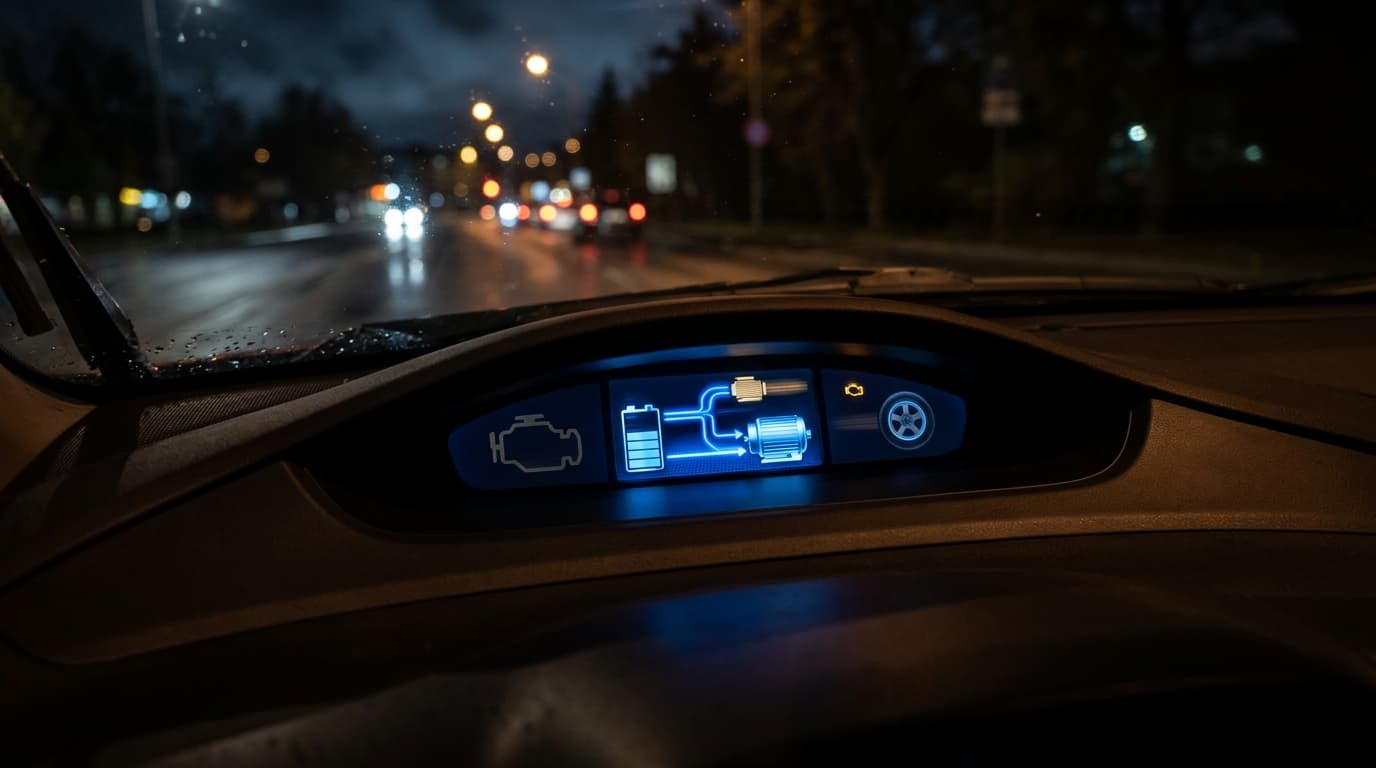
A hybrid car combines a combustion engine and an electric motor, and lets an electronic control unit decide continuously which of the two does the work. So much for the definition. The problem is that three very different cars are sold under that name in showrooms, and they will not save you the same money.
What exactly is a hybrid car?
A hybrid vehicle carries two energy sources: fuel, and electricity stored in what is called a traction battery. A control unit splits the effort between the two motors according to speed, acceleration demand and state of charge.
Two mechanisms do most of the work. The first is regenerative braking: when you lift off or brake, the electric motor becomes a generator and turns into electricity energy that would otherwise have gone to heat in the discs. The second is engine shutdown: at a standstill, on deceleration and sometimes at low speed, the petrol engine simply switches off.
That is why a hybrid shines in town and much less on the motorway. At constant speed on a main road there is almost nothing to recover and the engine runs continuously.
What is the difference between mild, full and plug-in hybrids?
It is structural, and it is the one thing to grasp before comparing any prices.
A mild hybrid, or MHEV, adds a 48-volt starter-generator. It helps on pull-away, recovers a little under braking and lets the engine shut down at a standstill. It never propels the car on its own. The gain is around 5 to 10 % in urban use — real, but nothing like what the word "hybrid" suggests.
A full hybrid, or HEV, has a much more powerful electric motor and a battery of a few kilowatt-hours. It drives on electricity alone, in bursts of a few hundred metres, whenever demand is light. It recharges as it drives: there is nothing to plug in.
A plug-in hybrid, or PHEV, is a full hybrid with a much larger battery and a socket. Charged, it covers an ordinary commute without ever starting the engine. Left uncharged, it carries 200 kilos of unused battery and burns more than an equivalent petrol car.
| What you experience | What it probably is | What to do |
|---|---|---|
| No socket on the car, a "hybrid" badge | Mild or full hybrid | Ask for the architecture in writing: the difference in behaviour is total |
| The car pulls away silently and runs 300 m on its own | Full hybrid (HEV) | Nothing: that is normal, it recharges as it drives |
| A charging flap alongside the fuel flap | Plug-in hybrid (PHEV) | Check you can charge at home before ordering |
| A quoted figure below 2 l/100 km | Plug-in hybrid measured with a full battery | Ask for the empty-battery figure, which is the one you will live with |
| The engine runs from start-up all winter | Full hybrid in cold weather | Nothing wrong: warm-up and cabin heating come first |
How much of the trip actually runs on electricity?
It depends on the architecture, and nobody asks in the showroom.
On a mild hybrid: not one kilometre. On a full hybrid, manufacturers quote proportions of time — not distance — often above half of an urban trip. That is credible in a city centre with frequent stops. On a main road it collapses. On the motorway it becomes marginal.
On a charged plug-in hybrid, a daily 30-kilometre run happens entirely on electricity, as long as the heater does not eat the range.
In my workshop years, the question that came up most often fitted in one sentence: "my car never drives on electricity". Nine times out of ten it was a mild hybrid, and the answer was that it never would.
Why does the quoted fuel figure never match yours?
Because the WLTP homologation procedure measures a plug-in hybrid with a full battery, then weights the result.
On a full hybrid the gap stays moderate: expect a tenth to a third more in everyday use, more in winter. That is a gap comparable to a petrol car's.
On a plug-in, the gap changes in nature. A figure of 1.1 l/100 km assumes a full battery at the start. The same vehicle, battery empty, drinks like a heavy petrol SUV — because that is exactly what it has become. The ratio between the two can reach a factor of three to four. That is why I never quote a PHEV consumption figure without stating the state of the battery.

What the word "hybrid" does not tell you
Before signing, these five points are worth more than any spec sheet:
- The actual architecture — MHEV, HEV or PHEV — as documented by the manufacturer, never as suggested by the badge.
- The traction battery warranty term, and above all its conditions: at some manufacturers, the year-by-year extension lapses if servicing leaves the network.
- The empty-battery consumption if it is a plug-in.
- The registration tax amount for your region: Wallonia, Brussels and Flanders do not calculate it the same way, and the gap on the same model is far from symbolic.
- The out-of-warranty battery replacement price, which in Belgium sits between €2,000 and €5,000 depending on the model and on whether a new pack, a refurbished pack or a module-level repair is fitted.
How do you know which one suits you?
The opening question is not about the car, it is about your home: can you plug in every evening?
If you can, and your daily trips fit inside the electric range, the plug-in is the only one of the three that will genuinely have you driving on electricity. If you cannot, the full hybrid is the default: nothing to plug in, and it works the moment you slow down. As for the mild hybrid, judge it as a slightly thriftier petrol car, and compare its price to a petrol car's.
To go further, the ranking of hybrids sold in Belgium states each model's architecture and battery warranty, the comparison tool puts them side by side, and the buying method walks through the five steps in order.
Battery warranty conditions are published by the manufacturers — Toyota Belgium sets out the annual extension mechanism in detail. For taxation and registration, the reference is the FPS Mobility and Transport. Reliability data by model is published every year by TÜV.
Comparator
Compare voitures hybrides side by side.
Compare now →
Frequently asked questions

Olivier a passé dix ans en atelier de concession dans le Hainaut, de 2011 à 2021, sur le poste qui reçoit les voitures dont le tableau de bord s'allume sans que personne ne comprenne pourquoi. Il a démonté des batteries de traction, mesuré des modules un par un, et expliqué à des dizaines de clients pourquoi leur consommation ne ressemblait pas à celle de la brochure. Depuis 2022 il compare les hybrides vendues en Belgique depuis l'autre côté du comptoir, relève les tarifs de remplacement en concession et les conditions de garantie de batterie constructeur par constructeur. Ce qui l'agace : le mot « autorechargeable », inventé pour vendre, qui laisse croire à un acheteur qu'il roulera à l'électricité gratuite, et les fiches techniques qui affichent une consommation mesurée batterie pleine sans jamais préciser ce qui se passe une fois qu'elle est vide.