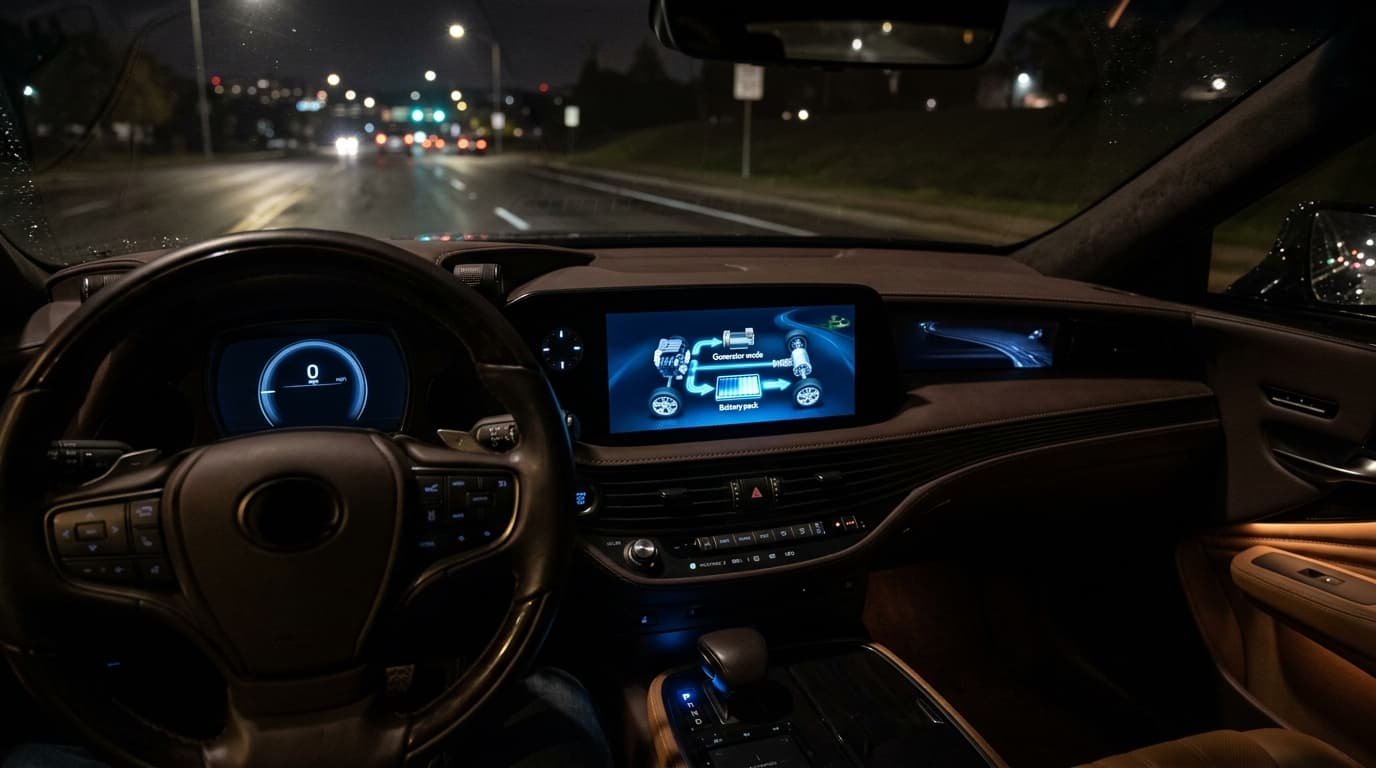
A REEV (Range Extended Electric Vehicle) is a car whose wheels are driven by an electric motor only, with a small petrol engine on board that has one job: making electricity when the battery is flat. It is a plug-in hybrid with a series layout, not an electric car.
What does REEV actually mean?
Range Extended Electric Vehicle. The petrol engine and its generator are the range extender.
The combustion engine has no mechanical link to the wheels. It runs at a roughly constant speed, spins a generator, and that electricity feeds the traction motor or tops up the battery. No gearbox, no clutch.
A useful order of magnitude: the battery of a REEV sold in Belgium holds between 17.8 and 28.4 kWh. That is ten to twenty times the battery of a full hybrid, and two to four times less than a family electric car.
How does a REEV differ from a plug-in hybrid?
In one way, and it changes how the car drives. On a conventional plug-in hybrid the combustion engine can drive the wheels itself, through a gearbox or a planetary gearset. On a REEV, never.
At the wheel that means no gear changes, no jolt when the engine starts, the same throttle response with a full or a flat battery. At the pump it means that once the battery is flat, all the energy goes through two conversions before it reaches the wheels, and on the motorway you pay for it.
European homologation makes no distinction. A REEV is measured like any PHEV, battery full then battery flat, with the same weighting. I went through that protocol in the article on plug-in hybrid real-world fuel consumption.
REEV, EREV, series hybrid: is it all the same vocabulary?
Nearly. Six terms turn up on spec sheets and in showrooms, and three of them mean the same thing.
| Term | Meaning | Does the engine drive the wheels? | Charging socket? |
|---|---|---|---|
| REEV | Range Extended Electric Vehicle | No | Yes |
| EREV | Extended Range Electric Vehicle, a synonym of REEV | No | Yes |
| Range extender | The combustion engine and its generator, taken on their own | No | Depends on the car |
| Series hybrid | Any hybrid where the engine only makes electricity | No | Not necessarily |
| Parallel hybrid | Engine and motor drive the wheels together | Yes | Not necessarily |
| Series-parallel hybrid | Switches between the two, like HEVs with a planetary gearset | Yes | Not necessarily |
The trap is in the fourth row. A series hybrid without a socket exists: Nissan sells it as e-Power. Same principle, a battery of barely a few kilowatt-hours, zero kilometres on grid electricity. That is an HEV, not a REEV.
Which REEV models are sold in Belgium?
Three, as far as I can tell, on 9 October 2026. The BMW i3 REx, discontinued years ago, only exists second-hand.
| Model | Architecture | Battery | Claimed electric range | Homologated CO2 | Belgian price | Recorded fuel use, battery flat |
|---|---|---|---|---|---|---|
| Leapmotor C10 REEV | Series PHEV, 68 hp 1.5 petrol | 28.4 kWh | 145 km | 10 g/km | €37,400 | 7.1 l/100 km over more than 350 km (AutoScout24 road test published 28/08/2025) |
| Leapmotor B10 Hybrid EV | Series PHEV, 1.5 petrol | 18.8 kWh | 86 km WLTP | 55 g/km | €30,400 list (Belgian page read on 09/10/2026) | No published reading at that date |
| Mazda MX-30 R-EV | Series PHEV, rotary engine | 17.8 kWh | 85 km WLTP | 21 to 22 g/km | €37,070 (Belgian dealer price list of January 2025, availability to be confirmed) | 8.8 l/100 km on a mixed urban route (Motor1 test of 29/02/2024) |
Traction battery warranty: 8 years or 160,000 km on the MX-30 according to a Belgian dealer page, and the same term in the Leapmotor network according to a French distributor page dated 30 June 2026. I could not find Leapmotor's Belgian wording. Have it written on the order form.
These figures come from manufacturer documents and published road tests. I have not driven any of these cars.
How much fuel does a REEV use once the battery is flat?
As much as a petrol SUV, sometimes more.
Take the C10. Leapmotor claims around 950 to 970 km of total range. The August 2025 test emptied the battery in 130 km, then recorded 7.1 l/100 km. With a 50-litre tank that makes 704 km on petrol, so 834 km in all. More than 100 km short of the promise.
Same sum on the MX-30: 50 litres at 8.8 l/100 km gives 568 km, after 70 to 78 electric kilometres according to the test. About 640 km, no more. On country roads the same test recorded 11.2 l/100 km, well above what drivers of full hybrids of that size report.
The NGO Transport & Environment looked at about twenty cars of this type sold in China and, in a note dated 25 July 2025, arrives at an average of 6.4 l/100 km with a flat battery. So the range extender is not a frugal back-up engine. It is a generator set, and it drinks like one.
Everything then hangs on the share of the trip actually driven on electricity. With 130 usable kilometres, the C10 covers a Charleroi to Brussels return trip without starting its engine, in mild weather. With 70 km, the MX-30 does not.
Is a REEV taxed like an electric car in Belgium?
No, in none of the three regions.
A REEV has a homologated CO2 figure and a piston (or rotary) engine: it is registered as a plug-in hybrid. In Flanders its registration tax comes out of the environmental formula, so in principle close to the minimum for the C10 at 10 g/km. In Wallonia and Brussels the displacement of the combustion engine counts, even though it never drives the wheels: a 1.5 gives 8 fiscal horsepower as a rule. The amounts per region are in the article on hybrid car registration tax in Belgium.
Look at the B10 above all: 55 g/km, where the C10 shows 10 with a bigger battery. Most of the gap comes from the new homologation method, which is stricter about the assumed electric share. And the Belgian threshold that separates a recognised plug-in from a "fake hybrid", for a company car, was 50 g/km. The tax guides I read on 9 October 2026 mention a raise to 75 g/km for cars homologated under the new method. I could not read it in an official text: check with FPS Finance or your accountant before ordering.
Four lines to get in writing before you sign
- The exact architecture: plug-in series hybrid, with the power of the combustion engine and the battery capacity.
- Fuel consumption with a flat battery, not the weighted catalogue figure.
- The traction battery warranty, in years, kilometres and percentage of capacity.
- The CO2 on the certificate of conformity and the homologation method, if the car goes through a company.
| Your situation | What to do |
|---|---|
| You charge at home and drive less than 100 km a day | A REEV does the daily run on electricity, the engine only works on holiday trips |
| You cannot plug in at home | Rule the REEV out: a full hybrid will use less |
| You mostly drive on the motorway | Compare with a plug-in hybrid whose engine drives the wheels |
| Company car ordered this year | Get the CO2 and the tax status confirmed in writing before the order form |
The Leapmotor B10 page for Belgium and the C10 REEV test by Touring carry the manufacturer values used here. To place these three cars against other plug-ins, start with the ranking of hybrids sold in Belgium, then the selection method, which opens with the only question that really sorts things out: can you plug in every evening?
Comparator
Compare voitures hybrides side by side.
Compare now →
Frequently asked questions

Olivier a passé dix ans en atelier de concession dans le Hainaut, de 2011 à 2021, sur le poste qui reçoit les voitures dont le tableau de bord s'allume sans que personne ne comprenne pourquoi. Il a démonté des batteries de traction, mesuré des modules un par un, et expliqué à des dizaines de clients pourquoi leur consommation ne ressemblait pas à celle de la brochure. Depuis 2022 il compare les hybrides vendues en Belgique depuis l'autre côté du comptoir, relève les tarifs de remplacement en concession et les conditions de garantie de batterie constructeur par constructeur. Ce qui l'agace : le mot « autorechargeable », inventé pour vendre, qui laisse croire à un acheteur qu'il roulera à l'électricité gratuite, et les fiches techniques qui affichent une consommation mesurée batterie pleine sans jamais préciser ce qui se passe une fois qu'elle est vide.