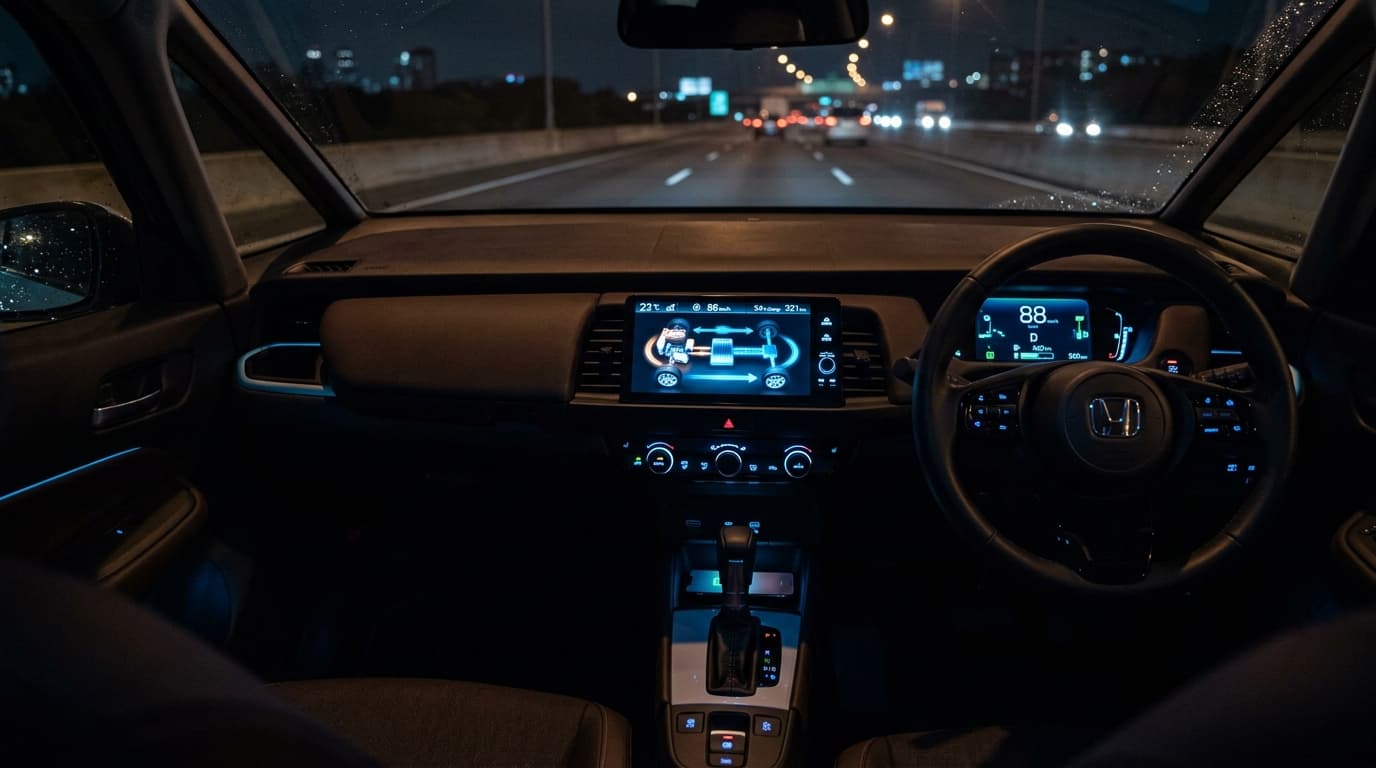
Honda Civic hybrid or Toyota Corolla hybrid: two full hybrids, no plug on either, and yet two opposite ways of moving the car. The Civic is driven almost entirely by its electric motor. The Corolla blends petrol and electric power all the time. For a commuter with no charger, I would take the Corolla if it is serviced at the dealer, and the Civic otherwise.
Two full hybrids that drive their wheels differently
The Corolla uses the layout Toyota has been selling for more than twenty-five years: a planetary gear set links the petrol engine, a generator and the electric traction motor. It is a series-parallel hybrid. At any moment, part of the 1.8's output goes mechanically to the wheels, another part goes through the generator, and the control unit sets the mix. There are no gears, hence the e-CVT and that engine note which rises before the speed does.
The Civic e:HEV takes the other route. Honda describes it on its own technology page: three modes. In EV mode, the battery alone powers the traction motor. In hybrid mode, the 2.0 runs but does not drive the wheels; it makes electricity for the electric motor, like a generator set. In engine mode, mostly when cruising at speed, a clutch connects the petrol engine directly to the wheels, on a single fixed ratio Honda likens to the top gear of a manual gearbox.
Put simply: in the Civic, it is nearly always 184 electric horsepower and 315 Nm that move the car. The 143 hp petrol engine only pushes it directly on the motorway. It is a series-dominant hybrid, and you feel it behind the wheel: the response is close to an electric car's.
I never had a Civic e:HEV on a lift. It reached Belgium in autumn 2022, after I had left the workshop. So I am comparing data sheets and logged figures, not memories of strip-downs.
The table, figure by figure
The data sheets come from both brands' Belgian websites and the real-world figures from Spritmonitor, all checked on 12 October 2026.
| Honda Civic e:HEV | Toyota Corolla 1.8 Hybrid | |
|---|---|---|
| Architecture | HEV, series-dominant full hybrid | HEV, series-parallel full hybrid |
| Petrol engine | 2.0, 1,993 cc, 143 hp | 1.8, 1,798 cc, 98 hp |
| Power that moves the car | 184 hp electric, 315 Nm | 140 hp combined |
| Transmission | fixed ratio, direct-drive clutch | e-CVT with planetary gear set |
| Traction battery | 1.05 kWh, 72 cells, 36.4 kg | lithium-ion, kWh capacity not published |
| 0 to 100 km/h | 7.8 s (Elegance) | 9.1 s |
| WLTP fuel consumption | 4.7 to 5.0 l/100 km, 108 to 115 g/km | 4.3 to 4.6 l/100 km, 97 to 104 g/km (provisional values) |
| Real-world consumption, Spritmonitor | 4.96 l/100 km, 4 cars of 184 hp | 5.22 l/100 km, 1,573 cars |
| Traction battery warranty | 8 years or 160,000 km, 70% capacity | 5 years or 100,000 km, extendable to 10 years at the dealer |
| Fiscal horsepower | 11 CV | 10 CV |
| Belgian list price | €36,290 (Elegance) to €40,795 (Advance) | €34,970, €29,990 after discount (offer valid until 31/10/2026) |
Two caveats. The Corolla figure mixes several generations and runs 12.6% above the catalogue value for the 650 cars where it is known. The Civic figure rests on four drivers, no more.
Which one uses less fuel in real life?
Neither pulls clearly ahead. I expected the Corolla to lead, because its system has twenty-five years of development behind it and a lower type-approval figure. The logs do not bear that out.
On Spritmonitor I isolated the 135 kW Civic e:HEVs built since 2023 with enough fill-ups to be readable: 4.31, 4.75, 5.22 and 5.54 l/100 km. Average: 4.96 l/100 km, over 112,729 km in total. Against that, the Corolla hybrid average comes to 5.22 l/100 km over 1,573 cars, all generations included.
To compare at similar power, I did the same with the 196 hp Corolla 2.0 built in 2023 and 2024: 4.77, 5.03, 5.14 and 5.46 l/100 km, a distance-weighted average of 5.09 l/100 km over 161,291 km. The two Japanese 2.0 engines end up a tenth of a litre apart.
Over 15,000 km a year, the gap between 4.96 and 5.22 l/100 km is about 39 litres of petrol. Too little, on too thin a Civic sample, to be a buying argument.
Does the Civic have an edge on the motorway?
In principle, yes. When cruising, the Civic couples its 2.0 to the wheels and skips the detour through the generator. The Corolla keeps its planetary gear set in the loop at every speed.
How much is it worth? No separate town and motorway logs allow me to put a number on it, and I will not invent one. At 120 km/h, every full hybrid runs mostly on petrol.
What battery warranty does each one get?
Honda covers the high-voltage battery for 8 years or 160,000 km, with a minimum capacity of 70%, according to its European warranty conditions in their 25 September 2023 version. The rest of the hybrid system, inverter, motor, converter, is covered for 5 years or 100,000 km. Condition: servicing according to the schedule, repairs at an authorised dealer.
Toyota Belgium covers the hybrid battery for 5 years or 100,000 km, then extends it by one year, 15,000 km at most, after each passed check at a Belgian or Luxembourg authorised dealer, up to the car's tenth year.
The sums depend on your garage. Serviced at the dealer for ten years, the Corolla stays covered two years longer than the Civic. Sent to an independent garage once the manufacturer warranty ends, it falls back to 5 years while the Civic keeps its 8. Once the warranty has run out, a new Toyota hybrid battery fitted at a dealer cost €2,000 to €5,000 at the last check, detailed in the article on the cost of a hybrid car battery. For the Civic I found no published Belgian price: ask the dealer for a written quote before you sign.
Eleven fiscal horsepower against ten
The Civic's 2.0 crosses the 1,950 cc line; the Corolla's 1.8 stays below it. In Wallonia, the road tax scale valid from 1 July 2025 to 30 June 2026 gives €415.40 for 10 CV and €539.09 for 11 CV, additional surcharges included. Gap: €123.69 a year, or €989.52 over eight years before indexation.
In Brussels, the indexed scale published in July 2023 gave €394.02 and €511.24, a gap of the same order. In Flanders, the annual tax on a recent car takes type-approved CO2 into account, where the Corolla also starts ahead (97 to 104 g/km against 108 to 115). Run the certificate of conformity through your Region's simulator before comparing discounts.
My verdict, profile by profile
Both are good full hybrids. They do not suit the same driver.
- Commuter in town and the suburbs, serviced at the dealer: the Corolla. Cheaper, 10 CV, and battery cover that can run for ten years.
- Driver who wants pull without paying for a plug-in: the Civic. 184 electric horsepower, 7.8 s from 0 to 100, for real-world fuel use at least as low.
- Owner who will switch to an independent garage after the manufacturer warranty: the Civic, for its 8-year battery cover that does not depend on a dealer check.
- High-mileage motorway driver: neither justifies its hybrid premium on that kind of road.
Before signing, whatever the brand, get these written on the order form:
- the traction battery warranty term and mileage, with the capacity threshold;
- the servicing conditions that keep it valid, authorised network or not;
- the fiscal horsepower and WLTP CO2 from the certificate of conformity;
- the end date of the discount offer.
The Corolla has already been set against the 308 in the Corolla hybrid or 308 hybrid head-to-head. The ranking of hybrids sold in Belgium covers other models on the same criteria, and the selection method helps you place your own use in the right box.
Comparator
Compare voitures hybrides side by side.
Compare now →
Frequently asked questions

Olivier a passé dix ans en atelier de concession dans le Hainaut, de 2011 à 2021, sur le poste qui reçoit les voitures dont le tableau de bord s'allume sans que personne ne comprenne pourquoi. Il a démonté des batteries de traction, mesuré des modules un par un, et expliqué à des dizaines de clients pourquoi leur consommation ne ressemblait pas à celle de la brochure. Depuis 2022 il compare les hybrides vendues en Belgique depuis l'autre côté du comptoir, relève les tarifs de remplacement en concession et les conditions de garantie de batterie constructeur par constructeur. Ce qui l'agace : le mot « autorechargeable », inventé pour vendre, qui laisse croire à un acheteur qu'il roulera à l'électricité gratuite, et les fiches techniques qui affichent une consommation mesurée batterie pleine sans jamais préciser ce qui se passe une fois qu'elle est vide.