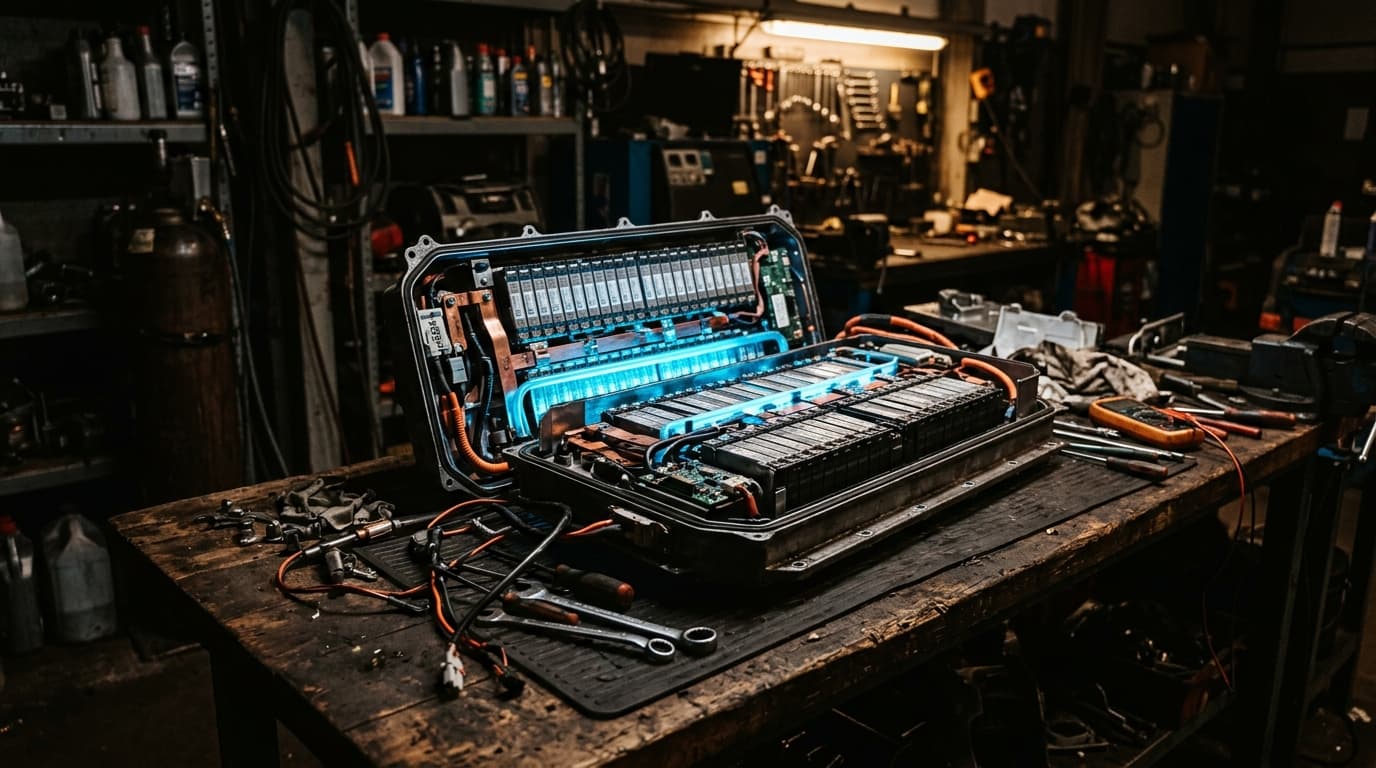
A hybrid traction battery is replaced in Belgium for 500 to 5,000 euros, and the gap between those two figures has nothing to do with the badge on the bonnet: it comes down to the route you choose and to what your service book says. Prices recorded on 18 September 2026. In a third of the cases I saw come through the workshop, the customer should not have paid anything at all.
How much does a hybrid car battery cost in Belgium?
Three prices exist for the same fault, and nobody ever lays them out side by side.
| Route | Scope of the work | Cover on the repair | Price recorded 18/09/2026 |
|---|---|---|---|
| New manufacturer pack, fitted by a dealer | New original battery, fitting and coding included | Manufacturer parts warranty | €2,000 to €5,000 |
| Reconditioned pack, independent specialist | Pack rebuilt with overhauled modules and rebalanced | 6 to 12 months depending on the workshop | €500 to €1,400 |
| Module-by-module repair | Only the faulty modules are replaced | 6 to 12 months, usually on the modules changed | €400 to €900 |
| Used pack fitted by a third party | Battery pulled from another car, condition unknown | None, or three months | €250 to €600 |
The reconditioned figures come from price lists published by specialists based in Belgium, among them Hybride Accu's Specialist, which lists refurbished packs from around 500 euros on second-generation Prius with six months of cover, rising to 1,200 to 1,400 euros on Yaris and Auris hybrids of the 2012 to 2019 model years with twelve months. All three are full hybrids, HEVs: no plug, the battery charges as you drive. Across that Toyota family, owner-reported consumption figures published on Spritmonitor, consulted on 18 September 2026, spread from 3.75 to 5.23 l/100 km depending on model year and use, and the battery leaves the factory with 5 years or 100,000 km of cover.
The last row of the table is there for completeness, not as a recommendation. A used pack with no charge history and no residual capacity measurement is a 400-euro lottery ticket.
Three routes, three bills with nothing in common
The price difference does not come from a difference in quality in the usual sense. It comes from what exactly gets replaced.
A full hybrid's traction battery is not a single solid block. It is an assembly of modules wired in series, each made up of cells, with management electronics watching voltage and temperature. On the nickel-metal hydride generations, the ones fitted to most of the Belgian used hybrid fleet, that means twenty to thirty modules in one casing.
The manufacturer replaces the whole casing. It is quick, it is traceable, it is guaranteed as a new part, and that is why the bill starts in four figures.
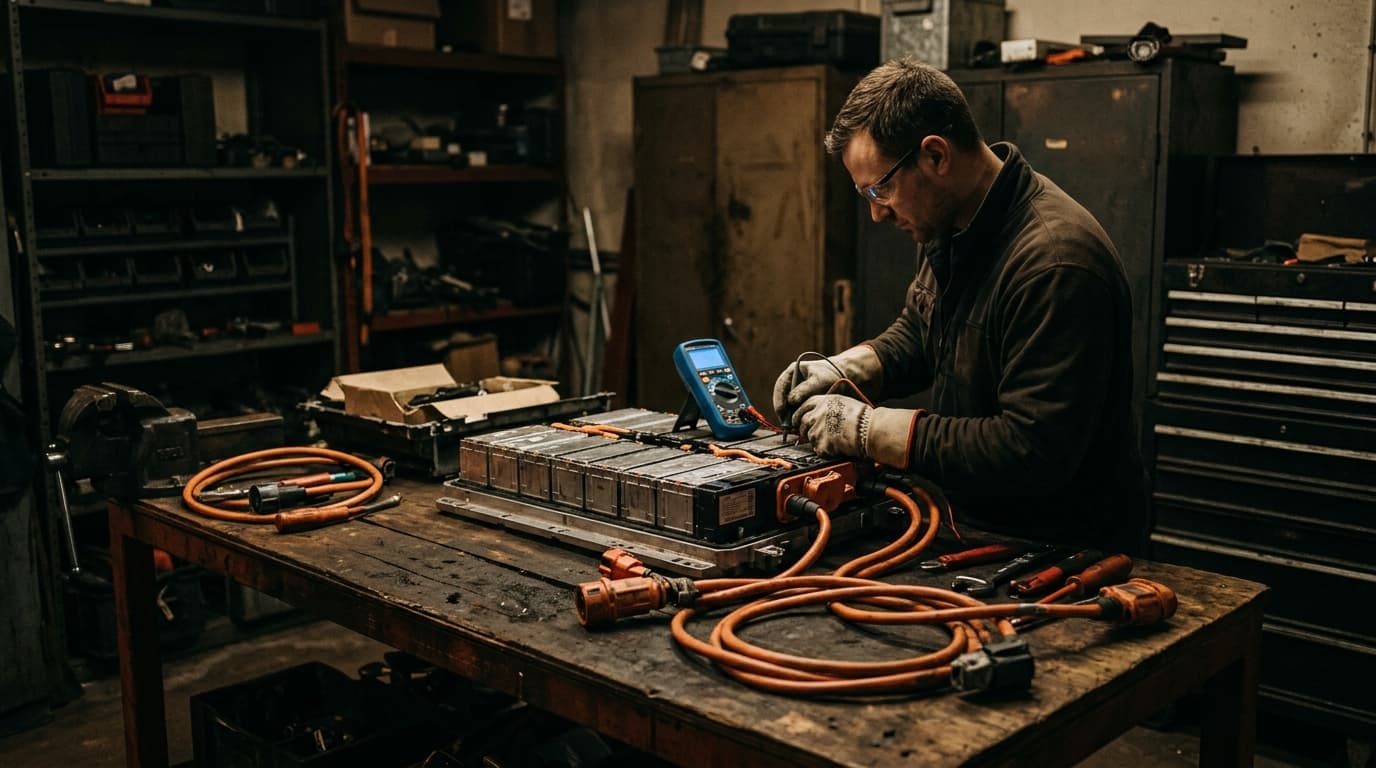
The independent specialist opens the casing instead. He tests every module under load, pulls the ones outside tolerance, replaces them with overhauled modules taken from other packs, then rebalances the whole thing before closing it up. The work takes longer, it needs a load bench and an operator certified for high voltage, and it is not backed by the manufacturer. The parts, though, cost far less.
That divergence in method is what explains the factor of five between the two quotes, not a difference in seriousness between the two workshops. The network sells a new part with the traceability that goes with it. The independent sells labour hours and a stock of sorted modules. Both are real trades, and the second one only exists because there is a great deal of usable material left in a pack declared beyond repair.
Does the whole pack need replacing?
Almost never, and that is the part of this job that irritated me most over ten years.
When a hybrid arrives with the red triangle and a fault code on the hybrid system, the diagnosis rarely reads "battery dead". It reads abnormal voltage on one identified cell block. Two modules out of twenty-eight, sometimes one. The other twenty-six are perfectly healthy and will do another hundred thousand kilometres.
At a dealership, the procedure is to change the casing. Not out of dishonesty: the manufacturer does not sell individual modules to its network, and a partial repair would fall outside the part's warranty framework. The technician quoting you 3,200 euros is not lying, he is applying what he is allowed to apply.
But you, the owner of a 2015 Auris hybrid worth 8,000 euros on the used market, have every right to know that the same fault is handled for 600 euros by a workshop willing to open the casing. Ask for the fault code in writing before you decide anything. It travels with you to the second opinion.
Your manufacturer's warranty decides whether you pay
Before any quote, open the service book. The amount you are about to spend is already written there, in negative.
| Brand | Original battery cover | Extension mechanism |
|---|---|---|
| Toyota and Lexus | 5 years or 100,000 km | +1 year or 15,000 km at every annual check in the approved network, up to the car's tenth year |
| Hyundai | 8 years or 160,000 km | No conditional extension, fixed cover |
| Kia, model years before 2026 | 7 years or 150,000 km, state of health ≥ 70 % | Fixed cover |
| Kia, model year 2026 onwards | 8 years or 160,000 km, state of health > 70 % | Fixed cover |
The Toyota case deserves a stop, because it is the most common on the Belgian market and the most widely misunderstood. Factory cover ends at 5 years or 100,000 km. But every annual visit to an approved Belgian or Luxembourg dealer, with a positive battery test, pushes it back by one year or 15,000 kilometres, and it does so until the car turns ten. Toyota Belgium documents it in black and white.
Translated into euros: an eight-year-old Corolla hybrid serviced at Toyota from day one still has its battery covered. The same car, serviced at the local garage from year four onwards, does not. The gap between those two owners, on the day a module fails, is three thousand euros.
I am not saying you must stay in the network at any cost. I am saying you cannot decide to leave it without putting that figure next to the annual saving on servicing.
The Korean brands went the other way, and credit to them for it: their cover is long and depends on no servicing condition. Hyundai Belgium states 8 years or 160,000 km on the high-voltage battery, Kia 7 years or 150,000 km with a 70 % state-of-health threshold on model years before 2026, raised to 8 years or 160,000 km afterwards. On a car kept for ten years, that clause is worth more than a 500-euro discount at order time.
The warning signs that come before the bill
A traction battery does not die all at once. It gives notice for months, and nobody listens. On the cars that came through the workshop, the same symptoms turned up in the same order:
- The electric share collapses. The energy flow screen shows fewer and fewer stretches in EV mode, including crawling through town, exactly where a hybrid should switch over every time.
- The charge gauge turns twitchy. It climbs and drops three bars within a few hundred metres instead of moving slowly. That is the signature of a module whose voltage sags under load.
- The petrol engine fires up the moment you set off, even in mild weather, even after a short stop, when it stayed silent for the first few seconds six months ago.
- Fuel consumption rises by 15 to 25 % on the same daily route, with no change in driving style or season.
- The battery fan becomes audible in town, often because its intake grille is clogged. It is the only item on this list you can deal with yourself, and it sometimes fixes everything.
That last point is worth its weight in gold. On the Auris and the Prius, the battery air intake sits under the rear bench or in the rear quarter panel, and it swallows dust, pet hair and crumbs for years. A module that runs hot ages fast. Cleaning that grille takes half an hour and costs nothing.
Since January 2026, recycling your battery is already paid for
Here is a Belgian detail most owners only discover when the quote lands, and it changes the end of the story.
Since 1 January 2026, buying a new electrified vehicle in Belgium comes with an environmental contribution earmarked for recycling the traction battery, on top of the 10 euros of vehicle contribution introduced on 1 January 2024 for passenger cars. The amount depends on the battery chemistry, nickel-metal hydride or lithium, and on its weight. It is collected by Febelauto, the Belgian producer responsibility organisation, and it explicitly covers batteries and modules replaced through after-sales work.
In practice, when your workshop drops off your old casing, collection and treatment are not billed back to you. If a quote shows disposal charges for the traction battery on a vehicle placed on the Belgian market, ask the question.
The volumes also say something useful about how often replacements really happen. Febelauto collected 31,585 kg of traction batteries in 2021, and 412,400 kg in December 2025, a growth of 1,200 % in four years. That sounds enormous. Set against the Belgian electrified fleet, it stays tiny: 5,079 batteries collected across the whole of 2024. Hybrid battery failure makes a great deal of noise on forums and very little tonnage in approved centres.
Change the car rather than the battery?
The question becomes serious beyond ten years, and the answer fits into one subtraction.
Take the market value of your hybrid today. Subtract the repair quote. If what is left is still more than an equivalent replacement car would cost you, repair it. A 2016 Yaris hybrid HEV valued at 7,500 euros, repaired for 700 euros at module level, stays well ahead of any 6,800-euro used replacement whose history you do not know.
The calculation flips when the car has other weaknesses queuing up: water pump clutch, sill corrosion, roadworthiness test in three months. The battery is then only the first item in a series.
On plug-in hybrids the arithmetic changes again. A PHEV battery carries five to ten times more capacity than a full hybrid's, and its replacement bill follows. A 3008 Hybrid4, a PHEV whose owner-reported figures on Spritmonitor sit around 4.1 l/100 km for drivers who charge regularly, and whose traction battery is covered for 8 years or 160,000 km with a 70 % minimum capacity, is nothing like an Auris to deal with. Out of warranty, the complete pack goes well beyond the top of my table, and the reconditioning trade is far less developed for it. On those cars the warranty is not a comfort: it is the whole of the reasoning.
To compare what each model states in architecture and battery cover before you buy, the ranking of hybrids sold in Belgium carries those two lines model by model, and the selection method walks through the steps in order. If you are not yet sure which of the three architectures sits under your bonnet, start with how a hybrid car works.
And if you take away one thing: get the service book out before you get the bank card out.
Comparator
Compare voitures hybrides side by side.
Compare now →
Frequently asked questions

Olivier a passé dix ans en atelier de concession dans le Hainaut, de 2011 à 2021, sur le poste qui reçoit les voitures dont le tableau de bord s'allume sans que personne ne comprenne pourquoi. Il a démonté des batteries de traction, mesuré des modules un par un, et expliqué à des dizaines de clients pourquoi leur consommation ne ressemblait pas à celle de la brochure. Depuis 2022 il compare les hybrides vendues en Belgique depuis l'autre côté du comptoir, relève les tarifs de remplacement en concession et les conditions de garantie de batterie constructeur par constructeur. Ce qui l'agace : le mot « autorechargeable », inventé pour vendre, qui laisse croire à un acheteur qu'il roulera à l'électricité gratuite, et les fiches techniques qui affichent une consommation mesurée batterie pleine sans jamais préciser ce qui se passe une fois qu'elle est vide.