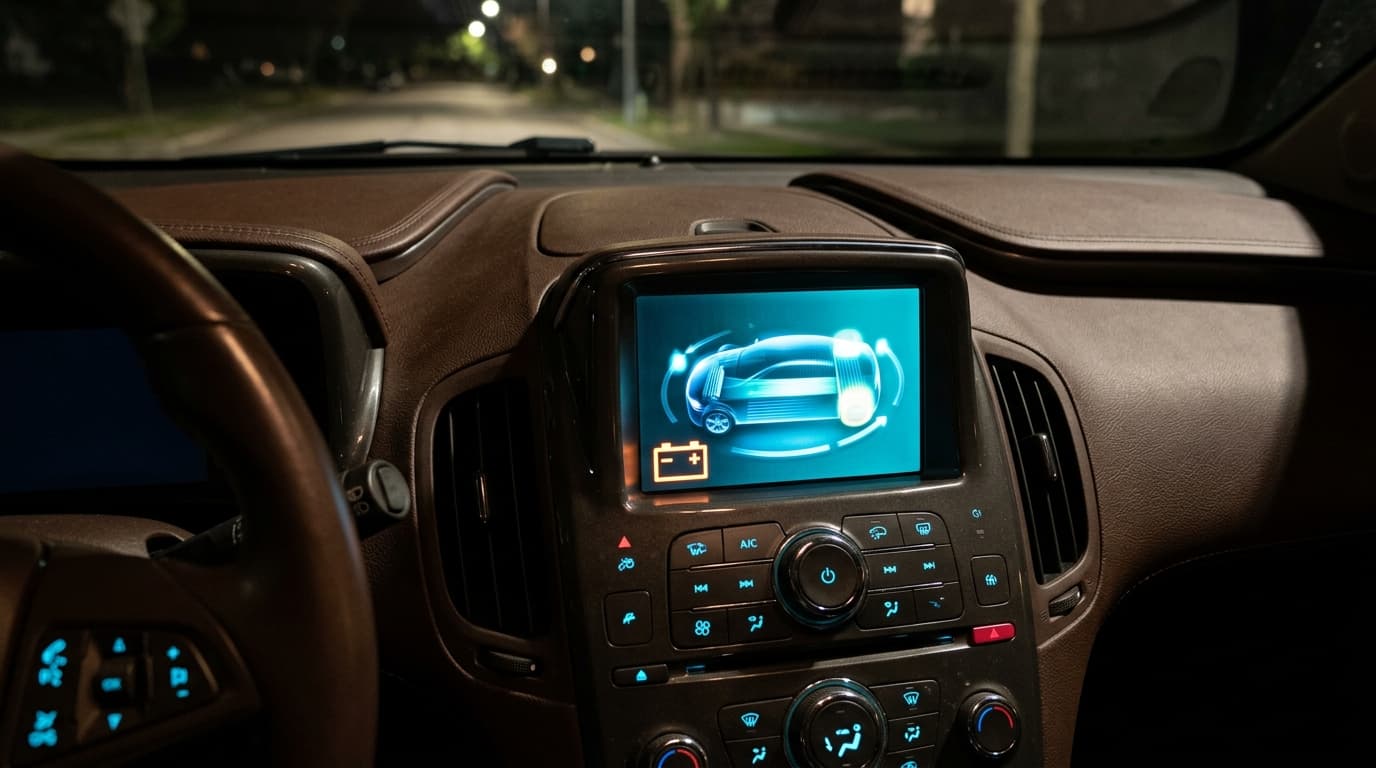
Yes, a hybrid car with a flat 12 V battery can be restarted with jump leads or a booster pack, provided you touch nothing but the 12 V circuit. On a full or plug-in hybrid, you only need to wake the electronics: the traction battery then starts the engine. Ten minutes of handling, then at least thirty minutes in READY mode.
Can you jump-start a hybrid with jump leads?
Yes. And it is easier than on a petrol car.
A petrol car asks its battery for several hundred amps to turn the starter motor. A full hybrid (HEV) or plug-in hybrid (PHEV) has no starter motor: its 12 V battery powers the control units and closes the relays that connect the traction battery. The traction battery, through the electric motor, is what fires up the combustion engine. So very little current is needed to get going again. But without that little current nothing lights up, not even the dashboard, and a full traction battery changes nothing.
The mild hybrid (MHEV) is the odd one out. It is jump-started like a petrol car, because it is one, with a starter-generator.
Why does a hybrid end up with a flat 12 V battery?
Because its 12 V battery is small and only recharges with the car switched on. I saw perfectly healthy three-year-old Auris hybrids come back to the workshop on a flatbed: three weeks in the car park at Charleroi airport, an alarm, a telematics box, and the battery was empty. Five-minute trips do the same job, more slowly.
The figures point the same way. ADAC, Europe's largest motoring club, publishes a breakdown of its callouts every year. I worked out the shares below from it.
| ADAC callouts in 2025 | Number | Share of total |
|---|---|---|
| All callouts | 3,691,813 | 100% |
| Caused by the 12 V battery | about 1,676,000 | 45.4% |
| On plug-in hybrids | 59,985 | 1.6% |
| On electric cars | 50,445 | 1.4% |
In Belgium, the roadside assistance club Touring does not publish such a detailed split. Le Moniteur Automobile, which relays its data (page consulted on 4 October 2026), ranks the 12 V battery second among breakdown causes behind the puncture, and reports that battery breakdowns on hybrids and electric cars have quadrupled in a few years. A failing traction battery remains rare. The small one is another story.
Where do the leads go, depending on the architecture?
Which of the three do you drive? The answer changes where the red clamp goes.
| Architecture | Role of the 12 V battery | Where to connect | Point to note |
|---|---|---|---|
| MHEV, mild hybrid | Cranks the engine through the starter or starter-generator | On the lead-acid 12 V battery, under the bonnet | Like a petrol car. The small lithium battery of the hybrid system is not to be touched |
| HEV, full hybrid | Wakes the control units, the traction battery starts the engine | On the jump terminal under the bonnet if the manufacturer provides one | 12 V battery often in the boot or under the rear seat |
| PHEV, plug-in hybrid | Same role as on an HEV | On the points shown in the manual | The charging cable does not replace jump leads |
Three cars to make it concrete, with the fuel consumption their drivers log on Spritmonitor.
The Suzuki Swift 1.2 Dualjet Hybrid is an MHEV: 5.34 l/100 km across 161 cars on 26 September 2026, with a 7-year or 150,000 km warranty and no separate line for the battery. It is jump-started on its lead-acid battery, like any Swift.
The Toyota Yaris Hybrid is an HEV: 4.81 l/100 km across 1,765 cars on 26 September 2026, traction battery covered for 5 years or 100,000 km, extendable until the car is 10 years old. Its 12 V battery is not always under the bonnet, depending on the generation. So Toyota placed a positive terminal under a red cap, in the fuse box of the engine bay.
The Kia Niro Hybrid is an HEV too: 5.03 l/100 km on 26 September 2026, battery covered for 7 years or 150,000 km before model year 2026, 8 years or 160,000 km after. Its plug-in version, a PHEV, shows 2.87 l/100 km across 309 drivers, full-battery and empty-battery trips mixed together, electricity not counted. Several Kia and Hyundai hybrids have an integrated lithium 12 V battery and a 12V BATT RESET button to the left of the steering wheel. The Kia manual for a 2024 hybrid is precise: start within 15 seconds of pressing it, then keep the car in READY mode or drive for 30 minutes in total. Does your car have one? As a rule, the manual says so on the breakdown page.
The procedure, step by step
Equipment: jump leads and a donor car, or a 12 V booster pack. Time: ten minutes.
- Make yourself safe. Parking brake on, P selected, ignition off, high-visibility vest on if you are at the roadside.
- Look for a reset button. If there is one, press it, start within 15 seconds and go straight to step 8.
- Find the intended positive point. Jump terminal under a red cap on a Toyota, battery terminal elsewhere. The manual decides.
- Red clamp on the positive of the stranded car, then on the positive of the donor car or booster.
- Black clamp on the negative of the donor car, then on a bare metal earth point of the stranded car, away from the battery.
- Wait two to three minutes, with the donor car's engine running.
- Foot on the brake, press the start button. The READY light comes on. The combustion engine may stay silent: that is normal.
- Remove the leads in reverse order and keep the car in READY mode, or drive, for at least 30 minutes.

The mistakes that cost money
- Putting a clamp on an orange cable or on the traction battery.
- Swapping red and black: on a hybrid, the control units and the converter do not always survive it.
- Putting the black clamp on the negative terminal of the flat battery instead of an earth point.
- Pressing the reset button again and again. Kia warns that repeated presses without 30 minutes of running afterwards drain the battery for good.
- Switching off after five minutes because the dashboard has come back on.
- Using a booster pack set to 24 V, meant for lorries.
Can a hybrid jump-start another car?
As a rule no, and most manufacturers advise against it. The 12 V battery of a full hybrid is not sized to deliver the current that a petrol or diesel starter motor swallows, and the surge can damage the converter that links the traction battery to the 12 V circuit. That part is not replaced for the price of a set of leads. If your manual allows it in black and white, follow it. Otherwise, lend a booster pack, not your car.
A lithium 12 V booster pack in the boot covers both situations, by the way, and brands such as NOCO or CTEK make them. If your hybrid is driven every day, you do not need one.
When should you call roadside assistance?
In four cases: the READY light does not come on despite the leads, a hybrid system warning light stays on after starting, the 12 V battery is swollen or smells of sulphur, or you are on the hard shoulder. On a motorway, the leads stay in the boot: you get behind the barrier and you call.
A 12 V battery that goes flat twice in a month needs replacing, not restarting. Ask for a load test at the next service, detailed in the hybrid car maintenance guide. The big battery raises other questions and other sums: see hybrid car battery cost in Belgium. And if you are still choosing between the three architectures, the ranking of hybrids sold in Belgium and the selection method give the type of hybrid and the battery cover for each model.
Comparator
Compare voitures hybrides side by side.
Compare now →
Frequently asked questions

Olivier a passé dix ans en atelier de concession dans le Hainaut, de 2011 à 2021, sur le poste qui reçoit les voitures dont le tableau de bord s'allume sans que personne ne comprenne pourquoi. Il a démonté des batteries de traction, mesuré des modules un par un, et expliqué à des dizaines de clients pourquoi leur consommation ne ressemblait pas à celle de la brochure. Depuis 2022 il compare les hybrides vendues en Belgique depuis l'autre côté du comptoir, relève les tarifs de remplacement en concession et les conditions de garantie de batterie constructeur par constructeur. Ce qui l'agace : le mot « autorechargeable », inventé pour vendre, qui laisse croire à un acheteur qu'il roulera à l'électricité gratuite, et les fiches techniques qui affichent une consommation mesurée batterie pleine sans jamais préciser ce qui se passe une fois qu'elle est vide.