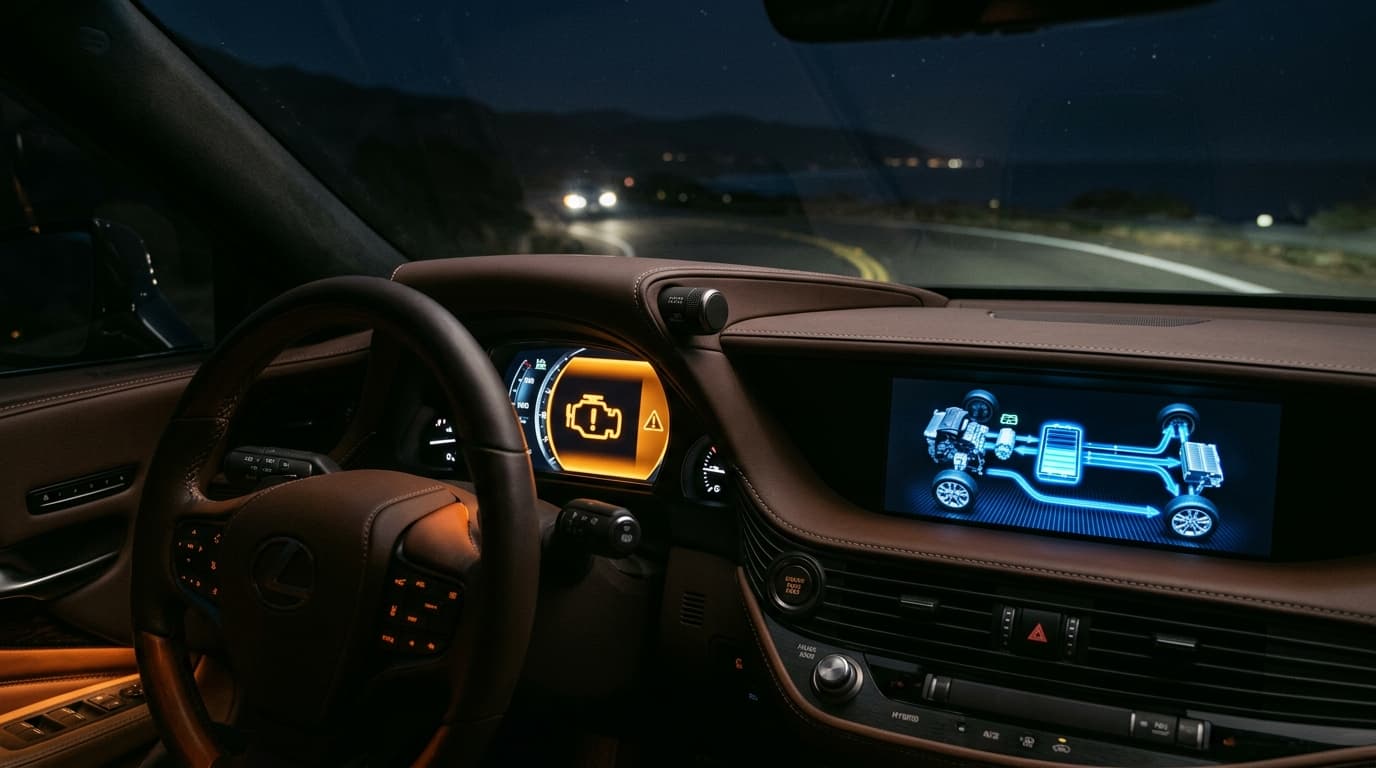
It depends on what comes with the message. On its own, with the car driving normally, a "check hybrid system" warning lets you drive to the nearest garage. With a continuous beep, a red triangle or a flashing READY light, you stop as soon as you can do so safely. Either way, you touch nothing that is connected by an orange cable.
Do you have to stop straight away?
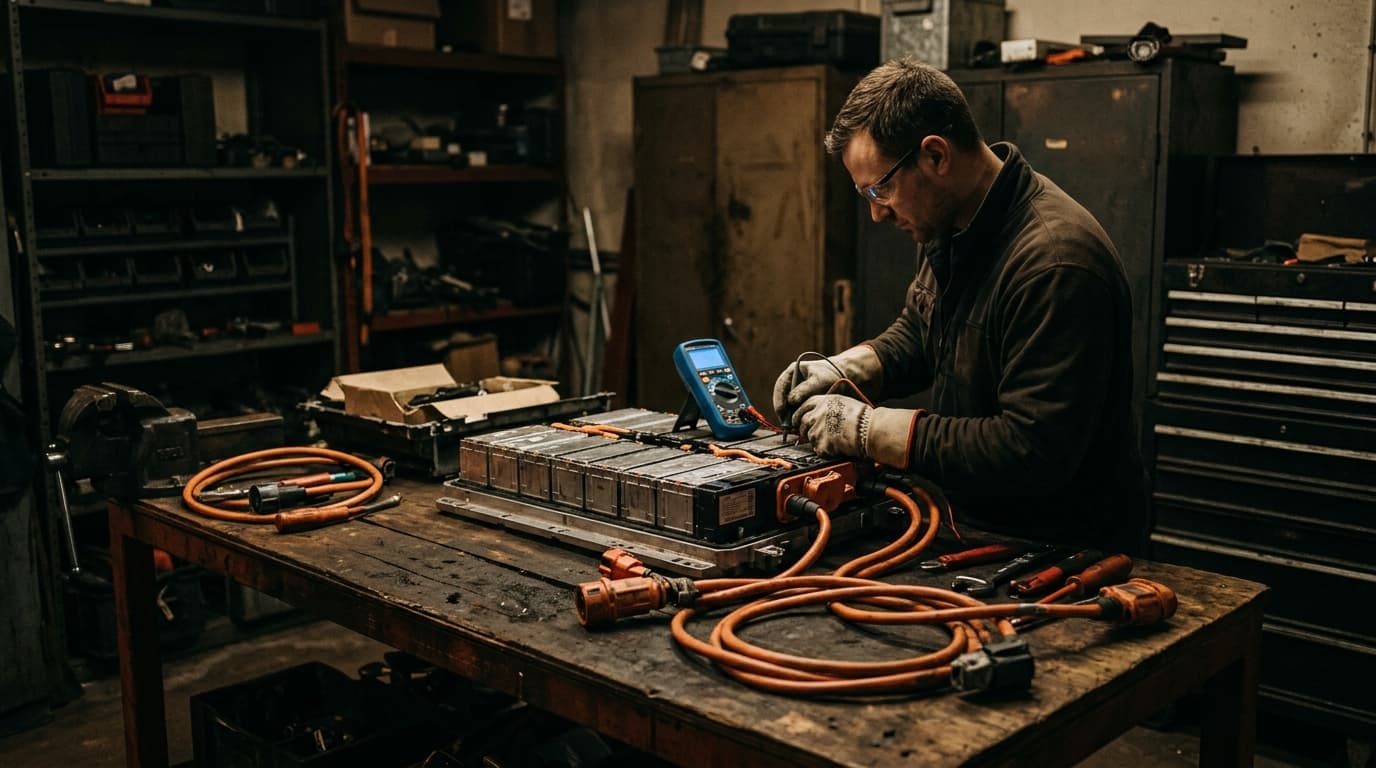
For ten years, from 2011 to 2021, I worked the workshop desk in Hainaut that took in these cars. Half of them arrived on a flatbed when they could have driven to us, and a few came in by road when they should never have left the car park.
The difference comes down to three signals: a beep that does not stop, a red triangle on the instrument cluster, and a READY light that flashes or goes out instead of staying steady. Any one of the three is enough to start looking for a place to stop.
What does each message mean, brand by brand?
The wording changes from one manufacturer to the next. The 2024 Kia owner's manual in French, shared by the full hybrid (HEV) and plug-in hybrid (PHEV) versions, is the clearest of the three I reread on 17 October 2026: it grades the severity itself.
| Message or light | Brand | Severity | What to do |
|---|---|---|---|
| "Check hybrid system", car normal | Kia | Medium | Avoid driving, go to the network without detour |
| "Check hybrid system. Stop safely", READY flashing, beep | Kia | High | Stop as soon as possible, tow truck |
| "Check hybrid system. Do not start the engine", beep | Kia | High | Do not restart: the hybrid battery is almost empty |
| Red triangle, beep, hybrid system fault | Toyota | High | Stop immediately in a safe place, call the dealer |
| Hybrid system overheating | Toyota | Medium | Park, let it cool, workshop if the message returns |
| Maintenance required for traction battery cooling parts | Toyota | Low | Drive on, have the filter cleaned or replaced within the week |
| Auxiliary battery insufficiently charged | Toyota | Low | 15 minutes in READY mode, test the 12 V battery if it returns |
| Red brake and amber regenerative brake lights together | Kia | High | Harder pedal, longer braking distance: tow it |
The Toyota messages come from the warning list of a Prius owner's manual, the Kia ones from the manual quoted above. Your car may use other words. The "warning messages" chapter of its own manual is the reference.
Why does the hybrid system go into fault mode?
Rarely because of the traction battery itself.
The hybrid control unit watches dozens of sensors. A battery temperature that runs too high, a cell voltage that drifts, a pump that no longer flows, a 12 V battery that collapses at start-up: all of it surfaces under the same generic message, because a manufacturer is not going to show a five-character code to a driver on the Charleroi ring road.
The causes I saw most often:
- a clogged battery air filter or intake grille, sometimes blocked by a blanket left on the rear seat of an Auris;
- a 12 V battery at the end of its life, which pulls the voltage down just as the control units wake up;
- a failing electric coolant pump on the inverter, the fault that gets expensive if you keep driving;
- a fault in another system, the petrol engine or the ABS, that the hybrid control unit reports in turn;
- software that needs updating, as on the 1.5 Yaris hybrids built from July to November 2020, whose system could shut down under hard acceleration according to Hella's technical note.
A worn traction battery eventually lights the warning too, but it usually gives notice well before, through fuel use that creeps up.
What should you do in the first ten minutes?
Look before you act. Write down or photograph the exact message, the state of the READY light, the outside temperature and what the car was doing: a loaded climb, an acceleration, a cold start.
Then, depending on severity:
- Beep, red triangle or flashing READY: hazard lights, stop as soon as the spot allows, select P, then call for assistance.
- Message alone, car normal: drive gently to the nearest garage, air conditioning off, avoiding the motorway if you can.
- Battery cooling message: check that nothing blocks the air grille near the rear seat, then book an appointment.
Only one case is in your hands: the 12 V battery. If the message mentions the auxiliary battery, leave the car in READY mode for a quarter of an hour. If it refuses to start, the jump-start procedure is in the article on jump-starting a hybrid with a flat battery.
Can you clear the fault yourself?
Technically yes, with an OBD reader costing a few tens of euros. Don't.
The fault code comes with a snapshot of the conditions at the moment of the fault: speed, temperatures, state of charge. Cleared, it takes the shortest route to the cause with it, and the technician has to wait for the fault to return to see it. On a Kia, the manual even says not to restart when the hybrid battery is almost empty.
Reading the code, on the other hand, harms no one.
Who pays for the repair under warranty?
The manufacturer, if the car has been serviced. The trap: the battery and the rest of the hybrid system do not have the same warranty, and the light does not say which of the two is at fault.
Three common full hybrids (HEV) in Belgium, with the fuel use their drivers log on Spritmonitor:
- The Toyota Yaris hybrid uses 4.81 l/100 km across 1,765 cars (logged on 26 September 2026). Toyota Belgium covers its battery for 5 years or 100,000 km, then extends it by one year with each passed test in the approved network, up to the car's tenth year. On this 2020 model the cooling filter, under the left side of the rear seat, is inspected every 15,000 km and replaced every 30,000 km.
- The Kia Niro hybrid runs at 5.03 l/100 km (logged on 26 September 2026), battery covered for 7 years or 150,000 km before the 2026 model year, 8 years or 160,000 km after.
- The Honda Civic e:HEV returns 4.96 l/100 km across only four cars (logged on 12 October 2026). Its European warranty conditions cover the battery for 8 years or 160,000 km at 70% capacity, and the inverter, electric motor and converter for only 5 years or 100,000 km.
Once the warranty has run out, the bill depends entirely on the code that is read. A filter costs tens of euros. A traction battery, thousands.
The roadworthiness test fails a car with a warning light on
AutoScout24 Belgium's guide to the roadworthiness test, updated on 12 June 2026, leaves no room for doubt: a warning light on the dashboard means automatic failure. The hybrid drivetrain itself is not measured there, as the article on the roadworthiness test for a hybrid explains, but the light can be seen.
To compare models, the ranking of hybrids sold in Belgium gives each one's architecture and battery warranty, and the buying method helps you decide which of the three architectures fits your driving.
Comparator
Compare voitures hybrides side by side.
Compare now →
Frequently asked questions

Olivier a passé dix ans en atelier de concession dans le Hainaut, de 2011 à 2021, sur le poste qui reçoit les voitures dont le tableau de bord s'allume sans que personne ne comprenne pourquoi. Il a démonté des batteries de traction, mesuré des modules un par un, et expliqué à des dizaines de clients pourquoi leur consommation ne ressemblait pas à celle de la brochure. Depuis 2022 il compare les hybrides vendues en Belgique depuis l'autre côté du comptoir, relève les tarifs de remplacement en concession et les conditions de garantie de batterie constructeur par constructeur. Ce qui l'agace : le mot « autorechargeable », inventé pour vendre, qui laisse croire à un acheteur qu'il roulera à l'électricité gratuite, et les fiches techniques qui affichent une consommation mesurée batterie pleine sans jamais préciser ce qui se passe une fois qu'elle est vide.