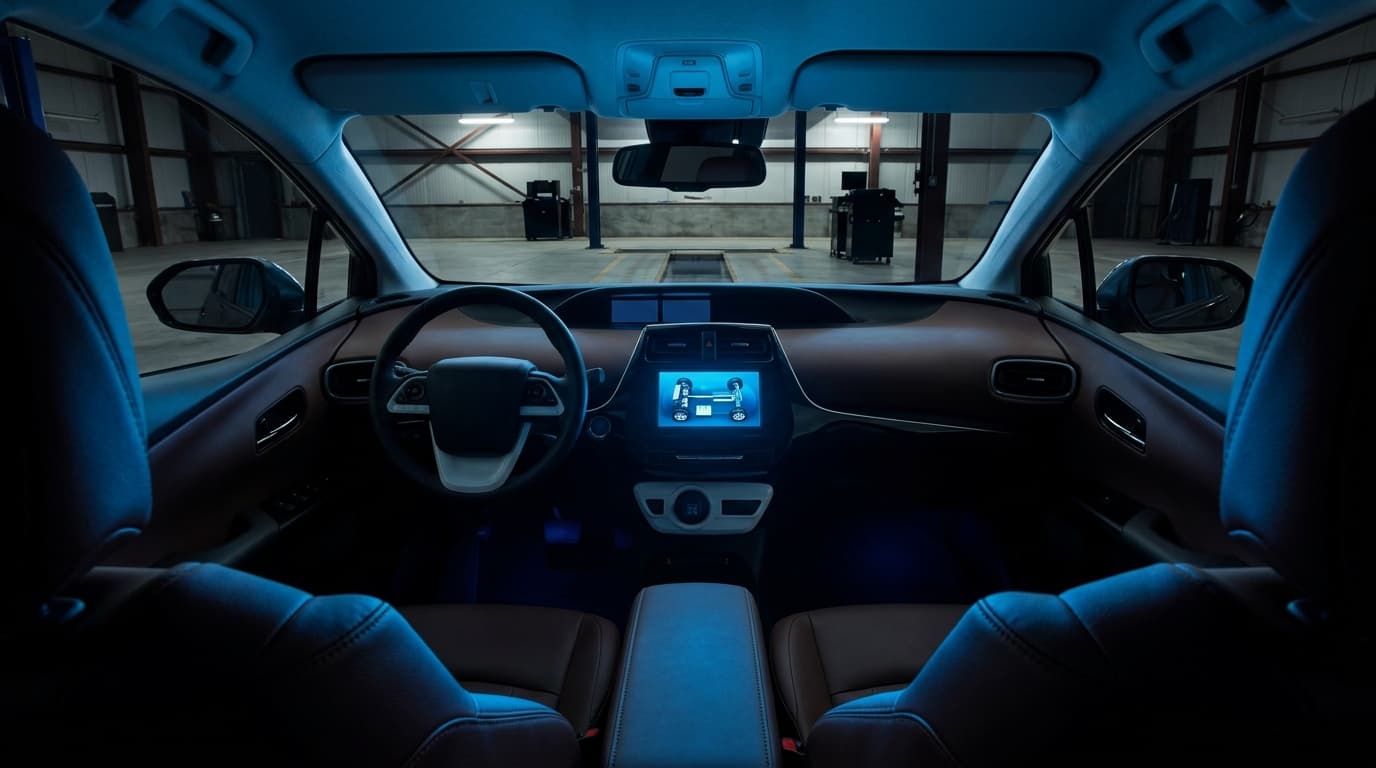
In Belgium a hybrid car takes the same periodic roadworthiness test (contrôle technique) as a petrol car: first visit at four years, 59.60 euros in Wallonia, 46.10 euros in Brussels and Flanders at 2026 rates. Nothing more, and that is the problem. The traction battery and the high-voltage circuit, the parts that make it a hybrid, are not measured.
To the test centre, your hybrid is a petrol car
Here is my thesis, stated up front: the Belgian inspection does not know it has a hybrid in front of it. It sees a petrol car that weighs a little more.
Brakes on the roller bench, lights, steering, suspension play, chassis, tyres, seat belts, identification, exhaust gas. The list is the same for a Yaris hybrid as for a petrol Yaris of the previous generation. Whether the car is a mild hybrid (MHEV), a full hybrid (HEV) or a plug-in hybrid (PHEV) changes neither the procedure nor the price.
That is a lot of cars. On 1 August 2023 Belgium had 537,817 hybrids on the road, 8.9% of the fleet, according to the count published by Touring. Every one that reaches four years old rolls through a centre carrying a component worth several thousand euros that nobody is tasked with looking at.
How much does the test cost for a hybrid?
The petrol price, to the cent. Each of the three Regions sets its own rates and calendar, and the rules that apply are those of the Region where the centre is located.
| Wallonia | Brussels | Flanders | |
|---|---|---|---|
| Periodic test for a petrol hybrid, 2026 rate | €59.60 (emissions included) | €40.90 + €5.20 = €46.10 | €40.90 + €5.20 = €46.10 |
| Same test for a fully electric car | €53.40 | €40.90 | €40.90 |
| Used-car test, Car-Pass not included | €89.40 | €74.40 | €74.40 |
| First visit | 4 years | 4 years | 4 years |
| Rhythm afterwards | 1 year | 1 year | 2 years since 01/09/2026 |
| Two-year bonus | up to 8 years and 110,000 km | under 6 years and 100,000 km | not applicable |
| Visits between year 4 and year 12, without bonus | 9, or €536.40 | 9, or €414.90 | 5, or €230.50 |
The Walloon rates come from the scale in force since 1 January 2026, published by AIBV, one of the two approved Walloon operators; those for Brussels and Flanders from the 2026 price lists carried by the Belgian motoring press, noted on 10 October 2026. The last row is my own calculation, at constant rates, for a car kept twelve years that never earns the bonus. With the Walloon bonus, extended on 1 January 2025 to cars of up to 8 years and 110,000 km, the bill drops by two or three visits.
The gap between a hybrid and an electric car fits on one line: 6.20 euros in Wallonia, 5.20 euros elsewhere. That is the price of the probe in the exhaust. The rest of the hybrid drivetrain is free, because it is not examined.
The traction battery is not checked
No capacity measurement. No module-by-module voltage reading. No insulation test on the high-voltage circuit.
Germany has started to move: ADAC offers a quick test with a plug-in box, TÜV an analysis of the state of health during a charge of about two hours. In Belgium, Pierre-Laurent Fassin of Autosécurité told Touring that comparable tests were not planned for now.
I understand why. The inspector has neither the manufacturer's tool nor the time for a charging session, and opening an orange housing is not part of the job. But the consequence is plain: a nine-year-old hybrid whose battery has clearly lost capacity drives away with the same green certificate as a car in full health. It uses more fuel, its combustion engine starts more often in town, and no official document says so.
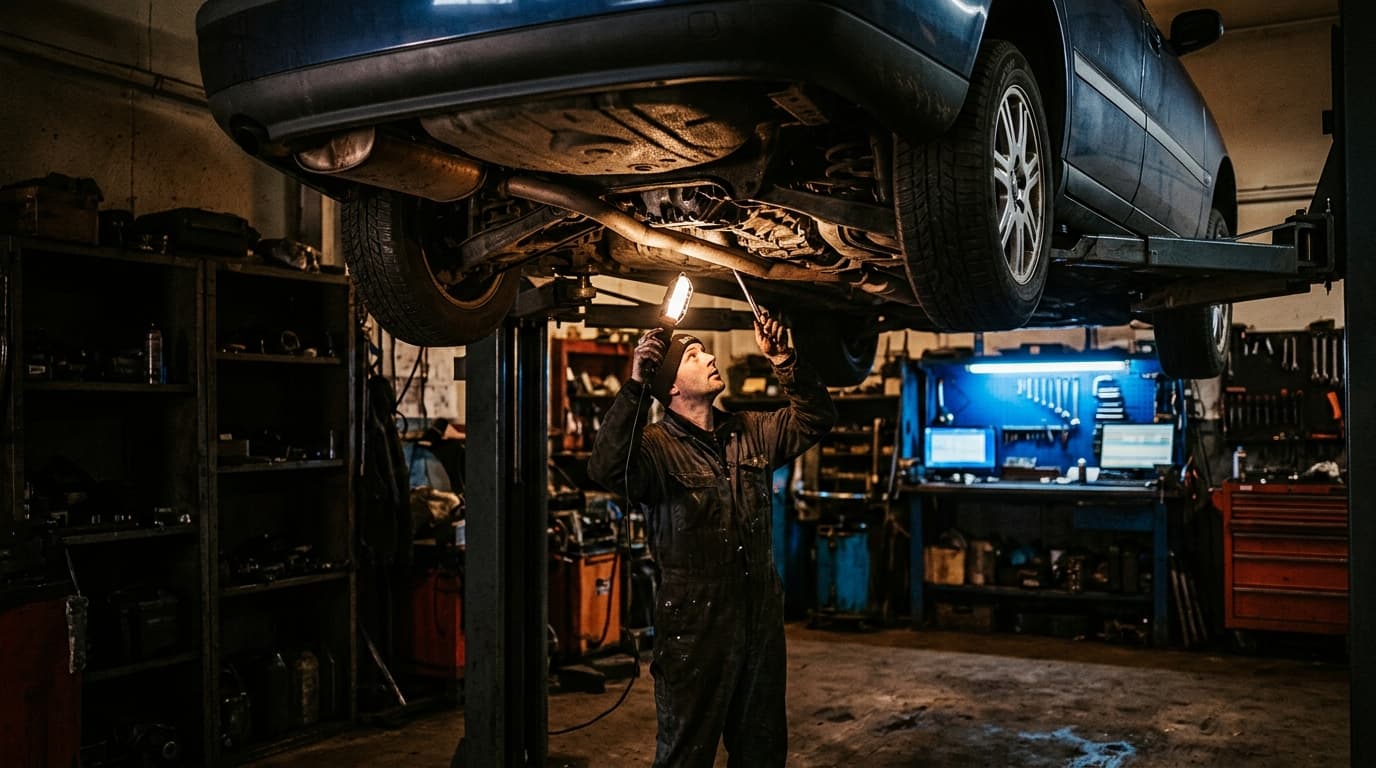
How do you measure the exhaust of an engine that switches itself off?
This is the one part of the test where a hybrid really stands apart, and not to its advantage.
The emissions test assumes a warm engine running at idle and then at a steady speed. A full hybrid does everything it can to avoid that: stationary, with a charged battery, its combustion engine shuts down. Manufacturers have planned for this. At Toyota, the repair manual describes a maintenance mode that forces the engine to run with the car standing still, for exactly this kind of measurement.
I found no public instruction from the Belgian centres explaining how they proceed model by model. In principle the inspector knows the routine on common hybrids. You can make it easier, especially with a plug-in:
- Drive for fifteen to twenty minutes before the appointment with the combustion engine running. On a PHEV, pick the mode that holds the battery charge instead of electric mode.
- If your plug-in runs almost always on its battery, take the combustion engine on a proper trip in the week before. An engine that has not warmed up for months is not at its best.
- If a hybrid system or engine warning light is on, have the fault code read before you book, not after.
- Arrive with the car empty, seats upright and tyres at the manufacturer's pressure: the weight of a hybrid does not forgive under-inflation on the brake bench.
The few diesel hybrids also take the particulate filter test, applied to diesels since 1 July 2022.
Do a hybrid's brakes fail more often?
This is the serious objection to my thesis, and it comes from the German figures. The inspection looks for nothing specific to hybrids, granted. But it still lands on their weak spots, since hybridisation wears a car differently.
The TÜV-Report 2026, published on 20 November 2025 and covering 9.5 million inspections, notes it for electric cars: regenerative braking uses the discs so little that they corrode and lose efficiency, and battery mass tires the axle suspension. The mechanism is the same on a hybrid, to a lesser degree. An HEV driven gently in town slows down mostly with its electric motor. Its pads last a long time, which is good news, and its discs corrode for lack of use, which is not.
On the roller bench a pitted disc shows up as an imbalance between left and right. On a hybrid that covers few kilometres, it is the first item to have checked before the appointment.
The cure costs nothing: a few firm brake applications a week, on a clear road, to clean the friction surfaces. I go through that item in the article on hybrid car maintenance.
Europe is preparing a high-voltage section
So the thesis holds, with a caveat about timing. The gap is European before it is Belgian, and it is being filled.
The minimum list of items to inspect comes from Directive 2014/45/EU, written when hybrids were a curiosity. On 24 April 2025 the Commission proposed revising it: a new section 4.14 on high-voltage systems, a check of electronic safety systems through the diagnostic port, and particle-number and nitrogen-oxide measurement in place of smoke opacity. The text is still under negotiation, and nothing says when or how the three Regions will transpose it.
Until then, a hybrid's green certificate vouches for its brakes and its lights. Not for its drivetrain.
On a used hybrid, the green certificate does not replace a battery test
Buying is where this gap gets expensive. And it is about to widen: from 1 January 2027, Flanders drops the mandatory pre-sale inspection for Belgian-registered cars holding a valid green certificate. With a two-year rhythm, you could buy a hybrid whose last examination dates back twenty months.
So ask the seller for the documents the centre does not produce:
- the hybrid battery test report from a brand dealer, less than a year old;
- the complete service book, because the battery warranty depends on it at several brands;
- the Car-Pass (the mandatory Belgian mileage certificate), to cross-check mileage against disc wear;
- a test drive in town with the energy-flow screen displayed, to see whether the car still switches to EV mode.
Two examples show what is at stake. A Toyota Yaris HEV leaves the factory with its battery covered for 5 years or 100,000 km, extended by one year at each annual check in the dealer network until the car is ten years old; driver logs published on Spritmonitor for that engine family, consulted on 18 September 2026, range from 3.75 to 5.23 l/100 km. A Peugeot 3008 PHEV, covered for 8 years or 160,000 km with a 70% minimum capacity, sits around 4.1 l/100 km in the same logs for drivers who charge it regularly, so with a full battery at departure. In both cases a tired battery pushes those figures up long before a warning light comes on, and the cost of a hybrid car battery out of warranty runs into thousands of euros.
The ranking of hybrids sold in Belgium gives the architecture and battery warranty length for each model, and the selection method runs through these checks in order.
The roadworthiness test will tell you whether the car brakes in a straight line. To know whether it still runs on electricity, you need a different piece of paper.
Comparator
Compare voitures hybrides side by side.
Compare now →
Frequently asked questions

Olivier a passé dix ans en atelier de concession dans le Hainaut, de 2011 à 2021, sur le poste qui reçoit les voitures dont le tableau de bord s'allume sans que personne ne comprenne pourquoi. Il a démonté des batteries de traction, mesuré des modules un par un, et expliqué à des dizaines de clients pourquoi leur consommation ne ressemblait pas à celle de la brochure. Depuis 2022 il compare les hybrides vendues en Belgique depuis l'autre côté du comptoir, relève les tarifs de remplacement en concession et les conditions de garantie de batterie constructeur par constructeur. Ce qui l'agace : le mot « autorechargeable », inventé pour vendre, qui laisse croire à un acheteur qu'il roulera à l'électricité gratuite, et les fiches techniques qui affichent une consommation mesurée batterie pleine sans jamais préciser ce qui se passe une fois qu'elle est vide.