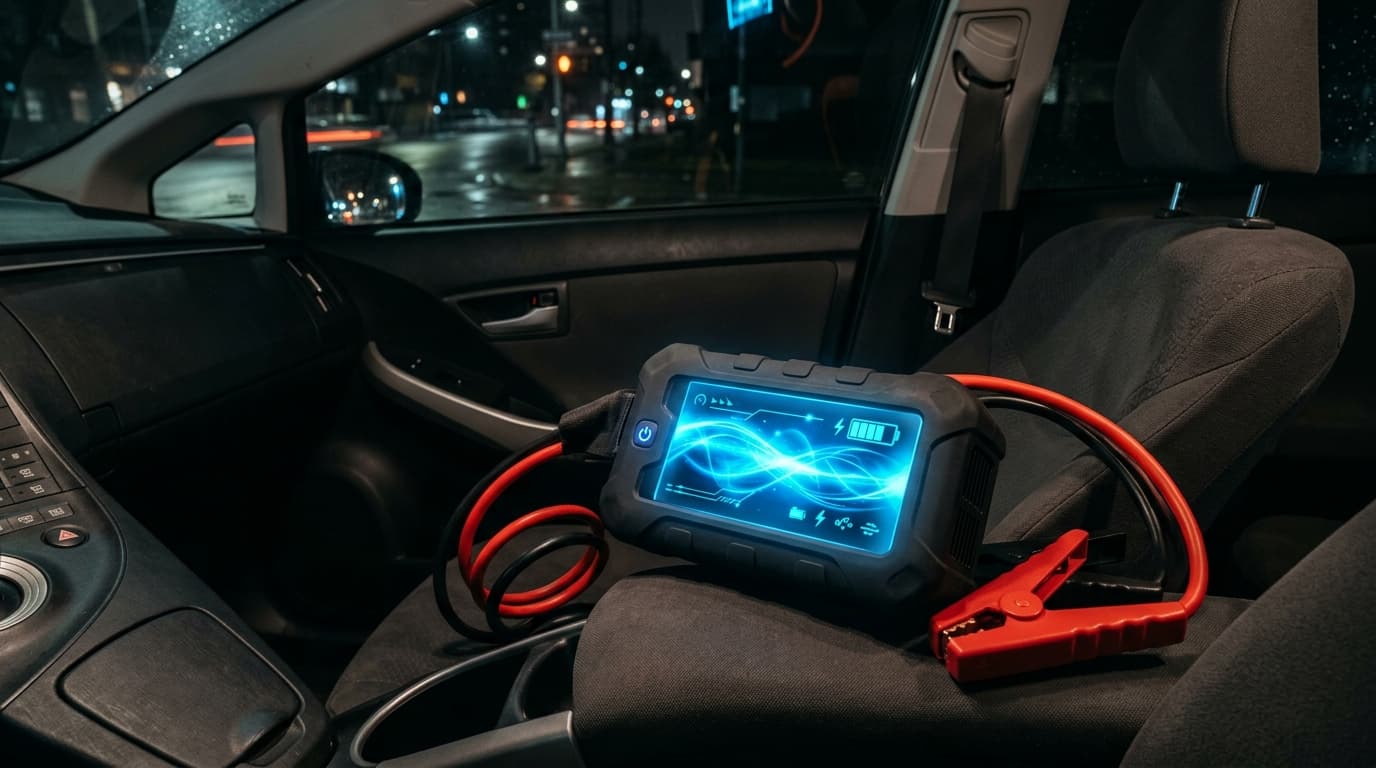
For a hybrid, the maintenance charger earns its keep more often than the jump starter. The jump starter revives a flat 12 V battery in ten minutes; the charger stops it going flat during three weeks of standing still. On a full or plug-in hybrid, the smallest 12 V jump starter is enough. And if the car is driven every day, buy nothing.
Jump starter or charger: which does what?
Both connect to the same place and do different jobs.
A jump starter is a portable energy reserve that releases several hundred amps for a few seconds. It recharges nothing. A charger plugs into the mains and pushes a few amps for hours, up to a full charge, then keeps the battery topped up. The jump starter fixes the breakdown, the charger avoids it.
The breakdown in question is ordinary. According to the ADAC, Europe's largest motoring club, the 12 V battery caused 45.4% of its 3,691,813 callouts in 2025. A hybrid is not spared: its 12 V battery is small and only recharges when the car is switched on.
A full hybrid starts on very little current
Packaging never says so, and it changes the whole purchase.
On a petrol car, the 12 V battery has to turn a starter motor: several hundred amps, more in cold weather. Jump starters are sold on that figure, in peak amps and litres of engine displacement. A full hybrid (HEV) or plug-in hybrid (PHEV) has no starter motor. The 12 V battery wakes the control units and closes the relays; the traction battery then starts the combustion engine through the electric motor. A few dozen amps are enough.
I spent ten years in a dealer workshop watching customers arrive with a recovery-grade jump starter, 2,000 A peak, bought for an Auris. It worked very well. It would also have started a diesel van. Nobody was asking it to.
The mild hybrid (MHEV) is the exception. It keeps a starter or a belt-driven starter-generator that draws on the 12 V lead-acid battery: size the jump starter as you would for a petrol car of the same displacement.
Four devices for a single 12 V circuit
The figures below come from manufacturer and distributor data sheets. I have not put any of these devices on a bench: I compare documentation, not tests.
| Jump leads | Lithium jump starter | Supercapacitor booster | Maintenance charger | |
|---|---|---|---|---|
| Example | 12 V jump lead set | NOCO Boost GB40 | GYS Startronic Hybrid 950 | CTEK MXS 5.0 |
| Job | Rescue with another car | Rescue on your own | Rescue on your own | Recharge and maintain |
| Stated figure | Depends on cable cross-section | 1,000 A peak, petrol up to 6 l, diesel up to 3 l | 750 A cranking, 2,500 A peak | 0.8 or 5 A, 8 steps, batteries from 1.2 to 110 Ah |
| What it needs | A donor car | Recharging from time to time | Almost nothing: the battery's residual voltage, or its lithium reserve | A 230 V socket near the car |
| Cold weather | Not applicable | Drops in severe cold | Rated from -40 to +65 °C | Built-in temperature compensation |
| Price checked in Belgium | Not checked | €110.52 (Galaxus.be, 06/10/2026) | Not checked | €177.93 incl. VAT (RS Belgium, 06/10/2026) |
Two remarks on this table. The word "Hybrid" in the Startronic's name describes its technology, supercapacitors backed by a small lithium battery, and not the cars it would be meant for. As for the CTEK price, it comes from a trade distributor, on a reference with a UK plug: that is the top of the range, and you need the version with a European plug.
Which device for which architecture?
Which of the three do you drive? The answer decides the equipment.
| Architecture | Starting demand | Jump starter | Maintenance charger |
|---|---|---|---|
| MHEV, mild hybrid | That of a petrol car: a starter to turn | Size it on engine displacement | Useful if the car sits idle, on the 12 V lead-acid battery |
| HEV, full hybrid | Very low: wake the control units | The smallest 12 V model is enough | The more useful of the two from two weeks of standstill |
| PHEV, plug-in hybrid | Very low, like an HEV | The smallest 12 V model is enough | Check the manual: some maintain the 12 V circuit while charging, others do not |
Three cars to make this concrete, with the consumption logged by their drivers on Spritmonitor on 26 September 2026.
The Suzuki Swift 1.2 Dualjet Hybrid is an MHEV: 5.34 l/100 km across 161 cars, warranty of 7 years or 150,000 km with no separate line for the battery. With its 1.2-litre petrol engine, any jump starter meant for a small city car will revive it.
The Toyota Yaris Hybrid is an HEV: 4.81 l/100 km across 1,765 cars, traction battery covered for 5 years or 100,000 km, extendable up to 10 years. It is the textbook case of the oversized jump starter. Its 12 V battery, often an AGM unit housed somewhere other than under the bonnet, does on the other hand appreciate a slow charger: several Toyota manuals set the limit at 5 A.
The Kia Niro Plug-in Hybrid is a PHEV: 2.87 l/100 km across 309 drivers, full and empty battery states mixed together, electricity not counted, battery covered for 7 years or 150,000 km before model year 2026, 8 years or 160,000 km after. Several Kia and Hyundai hybrids have a built-in 12 V lithium battery, with a reset button described in the Kia manual. On those, no conventional charger. The manual has the last word.
The criteria to read before buying
- Voltage: 12 V only. A switchable 12/24 V booster left on 24 V destroys control units.
- Protections: reverse polarity and spark-proof clamps. On a hybrid, a reversed connection can cost the converter that links the traction battery to the 12 V circuit.
- Behaviour with a very low battery. Some lithium jump starters refuse to deliver if they detect no voltage and then require a manual mode, which switches the protections off. Read the instructions before you need them.
- For a charger, current and technology: 5 A at most, and an AGM programme if your battery is one. The MXS 5.0 lists flooded, maintenance-free, gel, EFB and AGM lead-acid batteries.
- The protection rating, if the device lives in a damp garage: the GB40 and the MXS 5.0 are both rated IP65.
- Self-discharge of the jump starter. A lithium unit forgotten in the boot for two years is as flat as the battery it was supposed to save.
Do you really need to buy one?
Often not.
A hybrid driven twenty minutes a day keeps its 12 V battery healthy by itself. Nothing obliges you to equip yourself either: under the rules set out by the FPS Mobility and Transport (SPF Mobilité, the Belgian federal transport administration), the equipment required on board a car registered in Belgium stops at the triangle, the vest, the fire extinguisher and the first-aid kit. The roadworthiness test looks at neither leads nor jump starter. And if you have breakdown cover, through your insurer or the manufacturer, the patrol arrives with its own.
Buying makes sense in three situations. The car stands still for more than two weeks at a stretch, in a garage or an airport car park: take a maintenance charger if you have a socket, a jump starter if not. You only make five-minute trips: the charger, one night a month. You have already been rescued once for this reason: have the battery tested first, because a 12 V battery at the end of its life cannot be saved by either device.
A mains-powered combined charger and starter, the kind found in workshops, brings nothing to a full hybrid. It is heavy, it needs a socket, and its starting function answers a need your car does not have.
Two prices checked in Belgium, and a sum
On 6 October 2026, the NOCO Boost GB40 was listed at €110.52 at Galaxus.be, and the CTEK MXS 5.0 at €177.93 including VAT at RS Belgium. Both together: €288.45. That is real money for a breakdown that a call to your breakdown cover sometimes settles. Before taking both, ask which one answers yours.
The connection procedure, clamp by clamp, is described in the guide to jump-starting a hybrid car with a flat battery, and testing the 12 V battery is part of hybrid car maintenance. If you have not yet chosen between the three architectures, the ranking of hybrids sold in Belgium and the selection method give each model's hybridisation and battery cover.
Comparator
Compare voitures hybrides side by side.
Compare now →
Frequently asked questions

Olivier a passé dix ans en atelier de concession dans le Hainaut, de 2011 à 2021, sur le poste qui reçoit les voitures dont le tableau de bord s'allume sans que personne ne comprenne pourquoi. Il a démonté des batteries de traction, mesuré des modules un par un, et expliqué à des dizaines de clients pourquoi leur consommation ne ressemblait pas à celle de la brochure. Depuis 2022 il compare les hybrides vendues en Belgique depuis l'autre côté du comptoir, relève les tarifs de remplacement en concession et les conditions de garantie de batterie constructeur par constructeur. Ce qui l'agace : le mot « autorechargeable », inventé pour vendre, qui laisse croire à un acheteur qu'il roulera à l'électricité gratuite, et les fiches techniques qui affichent une consommation mesurée batterie pleine sans jamais préciser ce qui se passe une fois qu'elle est vide.