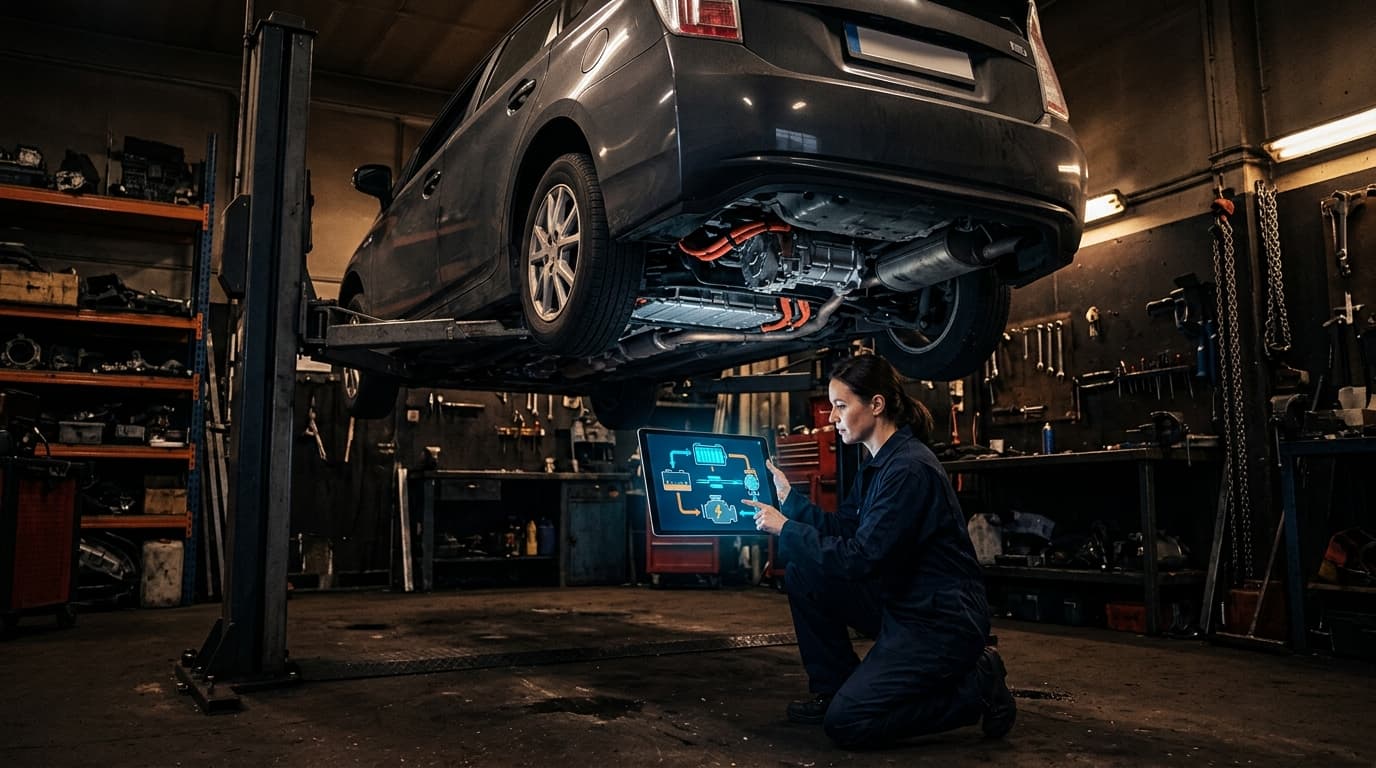
A hybrid car is serviced almost like a petrol car, with four extra items: the inverter cooling circuit, the traction battery ventilation, the 12 V battery and, on a plug-in, the charging socket and cable. Service every 15,000 km or 12 months at Toyota. The trap, though, hides in the service book.
What maintenance does a hybrid car need?
It all depends on which of the three you drive. I saw customers arrive at the workshop convinced their "hybrid" needed special treatment, when it was a mild hybrid serviced exactly like the petrol version. And the reverse: plug-in hybrid owners skipping the oil change because "the engine hardly ever runs".
| Architecture | Parts you no longer have compared with petrol | Extra items | Workshop watch point |
|---|---|---|---|
| MHEV, 12 V or 48 V mild hybrid | None: the petrol engine does all the work | Small lithium battery, belt-driven starter-generator | Auxiliary belt and tensioner, under more strain than usual |
| HEV, full hybrid | Starter motor, alternator, clutch | Inverter cooling circuit, traction battery ventilation, annual battery test | Brake discs rusting from lack of use |
| PHEV, plug-in hybrid | Varies by manufacturer | On-board charger, charging socket and cable, cooling for the large battery | Oil ageing even when the engine barely runs |
Three examples to anchor the figures, with what their drivers actually record on Spritmonitor, consulted on 26 September 2026.
The Suzuki Swift 1.2 Dualjet Hybrid is a 12 V MHEV: 5.34 l/100 km on average across 161 cars declared as hybrids. In the workshop it is handled like a petrol Swift. Suzuki Belgium covers it for 7 years or 150,000 km, with no separate line for the battery, provided it is serviced in the official network.
The Toyota Yaris hybrid is an HEV: 4.81 l/100 km on average across 1,765 cars, which is 32.9 % above the stated figure. Its traction battery is covered for 5 years or 100,000 km, extendable up to the vehicle's tenth year.
The Kia Niro plug-in is a PHEV: 2.87 l/100 km on average across 309 drivers, a figure that mixes trips on a full battery and on an empty one and leaves out the electricity. The plain Niro hybrid, which does not plug in, runs at 5.03 l/100 km: that is roughly where a plug-in climbs back to once nobody charges it. Kia covers the battery for 7 years or 150,000 km on model years before 2026, and 8 years or 160,000 km after that.
How often should a hybrid be serviced?
At Toyota, every 15,000 km or every 12 months. Whichever comes first.
The second limit is the one people forget. A pensioner's Auris covering 4,000 km a year would reach us with oil more worn out than a taxi's, because a hybrid's engine starts and stops dozens of times per trip, often without reaching temperature. Condensation water and a little petrol get into the sump, and the oil turns acidic. The odometer does not show it, the calendar does.
Servicing a hybrid, step by step
I did it in this order, and you can read your invoice the same way.
- Diagnostic read-out and traction battery test. At Toyota, this annual check is what the cover extension depends on. Ask for the written report: it shows the condition of the cell blocks and will help you when you sell.
- Oil and oil filter change. Recent hybrid engines need a very thin oil, often 0W-16 or 0W-20 depending on the service book. A "universal" 5W-30 has no business being there.
- Engine air filter and cabin filter. Nothing specific, except that on Toyota hybrids the air conditioning often runs with the petrol engine off, thanks to an electric compressor: a clogged cabin filter is noticed quickly.
- Battery fan grille and filter. On Toyotas, the air intake sits under the rear bench or in the rear quarter pillar. A battery that cannot breathe runs hot, and a battery that runs hot ages fast.
- Inverter cooling circuit. It has its own expansion tank, separate from the engine's. The level is checked at every visit; the first coolant change comes late, often beyond 150,000 km depending on the generation. The service book is the reference.
- Brakes. Discs and callipers checked, brake fluid every two years. Some hybrids need a workshop mode set through the diagnostic tool before the circuit is bled: a garage unaware of it can trigger a fault.
- 12 V battery. Load test at every service. It is smaller than on a petrol car, since it does not crank the engine, and a car left in the garage for three weeks drains it without warning.
- Depending on the architecture. On a PHEV, inspection of the socket, the flap and the insulation of the charging cable, mode 2 as well as mode 3. On an MHEV, condition of the auxiliary belt and the starter-generator tensioner.
Do brake pads wear less on a hybrid?
Yes, much less. The electric motor slows the car while recharging the battery, and the friction brakes only come in at the very end of a stop or under heavy braking.
The flip side, I saw it a hundred times on Yaris with 40,000 km: rear discs pitted with rust, because they almost never rub. At the Belgian roadworthiness test, braking efficiency is measured on a rolling bench, and a corroded disc brakes poorly. Braking firmly now and then, on a clear road, is often enough to clean them.
Can an independent garage service a hybrid?
Yes, legally. EU Regulation 461/2010 guarantees free choice of repairer: the legal warranty stands as long as the manufacturer's service schedule is followed with parts of equivalent quality.
Technically, it all depends on the workshop. In Belgium, the sector issues safety certificates for hybrid and electric vehicles on four levels, valid for six years. The first allows work on the car but not on the high-voltage system; from the second level up, the technician may work on the high-voltage circuit after isolating it. Before handing over your car, ask these questions:
- Does your technician hold a level 2 certificate or higher for hybrid vehicles?
- Does your diagnostic tool read the condition of the traction battery blocks, or only engine codes?
- Which oil do you use, and does it meet the specification written in the service book?
- Will the service book be stamped with the detail of the work, battery filter included?
- Who takes the car back if a hybrid fault lights up after your visit?
Leaving the network sometimes costs a battery
The legal warranty does not change. Commercial extensions do. Recorded from the manufacturers' Belgian pages on 26 September 2026:
| Brand | Cover at stake | Lost outside the network? |
|---|---|---|
| Toyota and Lexus | Hybrid battery: +1 year or 15,000 km at every positive test in the network, up to 10 years; Toyota Relax warranty of one year, renewable up to 10 years or 185,000 km | Yes, both |
| Suzuki | 7-year or 150,000 km warranty: 3 factory years extended by 4 years by Suzuki Belgium | Yes, for the 4 extension years |
| Hyundai | High-voltage battery 8 years or 160,000 km | No, fixed cover if the service schedule is followed |
| Kia | Battery 7 years or 150,000 km before 2026, 8 years or 160,000 km after | No, fixed cover if the service schedule is followed |
The Toyota case weighs the most. The hybrid battery cover extension only applies to servicing in the approved Belgian or Luxembourg network, and the Toyota Relax warranty follows the same rule. Yet a new traction battery fitted by a dealer cost 2,000 to 5,000 euros at the last price check, detailed in the article on hybrid car battery cost in Belgium. Put that figure next to the annual saving promised by the local garage before you decide.
Does a plug-in hybrid that rarely runs on petrol still need an oil change?
Yes, every year. A plug-in charged every evening may only cover a few thousand kilometres a year on petrol, but its oil goes through the same cold starts and the same condensation as anywhere else. The service book's calendar applies, even when the odometer seems to say otherwise.
To find out which of the three architectures sits under your bonnet, start with how a hybrid car works. If you are still at the buying stage, the ranking of hybrids sold in Belgium lists architecture and battery cover model by model, and the selection method helps you decide. And keep the service book up to date: it is what pays for the battery, the day it needs replacing.
Comparator
Compare voitures hybrides side by side.
Compare now →
Frequently asked questions

Olivier a passé dix ans en atelier de concession dans le Hainaut, de 2011 à 2021, sur le poste qui reçoit les voitures dont le tableau de bord s'allume sans que personne ne comprenne pourquoi. Il a démonté des batteries de traction, mesuré des modules un par un, et expliqué à des dizaines de clients pourquoi leur consommation ne ressemblait pas à celle de la brochure. Depuis 2022 il compare les hybrides vendues en Belgique depuis l'autre côté du comptoir, relève les tarifs de remplacement en concession et les conditions de garantie de batterie constructeur par constructeur. Ce qui l'agace : le mot « autorechargeable », inventé pour vendre, qui laisse croire à un acheteur qu'il roulera à l'électricité gratuite, et les fiches techniques qui affichent une consommation mesurée batterie pleine sans jamais préciser ce qui se passe une fois qu'elle est vide.