It depends on which of the three hybrid systems you mean. A mild hybrid (MHEV): zero kilometres. A full hybrid (HEV): engine off over 40 to 50% of the distance, but only a few kilometres in a row on the battery. A plug-in hybrid (PHEV) charged every evening: 50 to 80 real km per charge.
How many km does a hybrid really cover on electric power?
The salesperson and the driver are not talking about the same kilometre. There is the kilometre covered with the engine off, when the car coasts, brakes while recovering energy or creeps along on its battery. And there is the kilometre drawn from the electricity grid, charged at a socket. Only a plug-in hybrid knows the second kind.
| System | Kilometres in a row on the battery | Share of distance with engine off | Where the energy comes from |
|---|---|---|---|
| Mild hybrid (MHEV, 48 V) | 0 | close to zero | fuel only |
| Full hybrid (HEV) | a few kilometres, at low speed | 40 to 50% on a mixed trip | fuel, recovered under braking |
| Plug-in hybrid (PHEV), charged | 50 to 80 real km depending on battery | up to 100% within range | grid electricity, then fuel |
| Plug-in hybrid, never charged | a few kilometres, like an HEV | similar to an HEV | fuel only |
The figures in the middle column come from published data, not from my own drives: I have no test car, I compare manufacturer data, studies and drivers' logs, with their dates.
Does a mild hybrid drive on electricity?
No. Its 48 V starter-generator helps the petrol engine restart and accelerate, then recovers a little energy under braking. It has neither the power nor the battery to move the car on its own. A spec sheet that says "electrified" on an MHEV is telling the truth about the wiring and nothing about the trip.
How many km on electric power with a full hybrid?
On a mixed trip, roughly half the distance with the engine off, but never more than a few kilometres in a row on the battery alone. Both figures are true at the same time, and that is what confuses everyone.
In 2023 Toyota published data from 117,196 Yaris Hybrid (HEV) cars in the UK, covering 155 million kilometres between January and June: 42% of the distance and 56% of driving time in electric mode, calculated over the periods when fuel consumption was close to zero. In 2018, two researchers from École Polytechnique and CentraleSupélec drove four Toyota full hybrid saloons 81 times around a 33 km loop south of Paris: 51.4% of the distance with the engine off, 77.4% in the urban section.
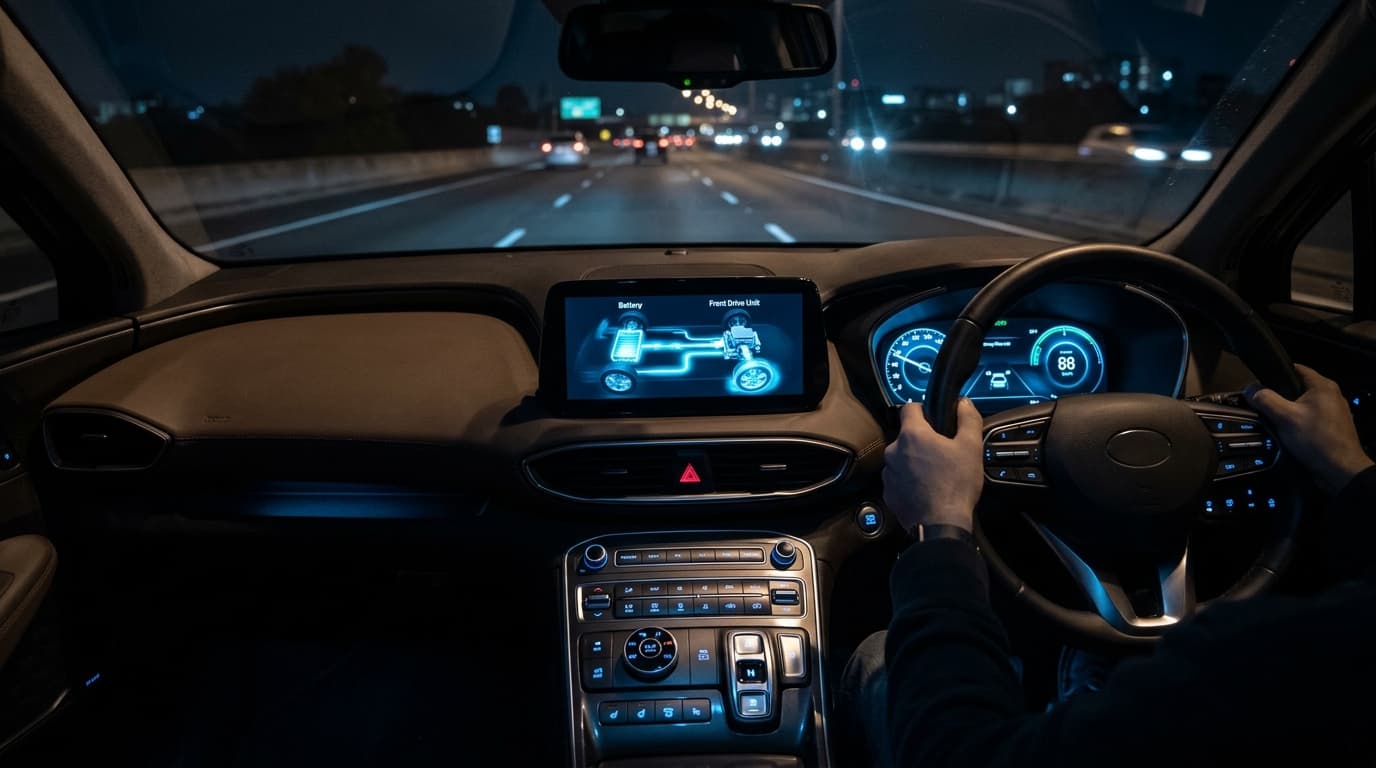
At the workshop counter, I used to put customers in front of the energy flow screen and point one thing out. The green arrow running from the battery to the wheels never lasts long. Most of an HEV's "electric" kilometres are lifts off the accelerator, downhill stretches and slowdowns where the engine stops because nothing is being asked of it. It is useful, and it shows at the pump. But it is not driving on electricity.
For reference, Yaris drivers record 4.81 l/100 km (Spritmonitor, 26 September 2026), and Toyota warrants its traction battery for 5 years or 100,000 km, extendable up to 10 years subject to servicing conditions.
What does the EV mode button do on a Toyota?
It stops the engine from starting for a short while. Handy for leaving an underground car park, crossing a residential street at walking pace or finishing a manoeuvre. It switches off by itself as soon as the battery drops, the speed rises or you press the pedal. Hyundai says it plainly about its own full hybrids: this mode only lasts a few kilometres. Forcing it from cold, before the engine has warmed up, delays the engine reaching temperature: I don't see the point.
What electric range does a plug-in hybrid have?
About three quarters of the homologated figure in real use, less again in winter and on fast roads. Test-Achats puts most 10 to 15 kWh plug-in hybrids at around 50 km, with large batteries reaching 70 to 90 km.
The Kia Niro Plug-in Hybrid (PHEV) claims 65 km WLTP with an 11.1 kWh gross battery: count on about fifty kilometres, 49 applying the quarter rule. Its drivers record 2.87 l/100 km across 309 cars (Spritmonitor, 26 September 2026), full and empty battery mixed. The battery is warranted for 7 years or 150,000 km on pre-2026 cars, 8 years or 160,000 km after that.
The Mercedes-Benz C 300 e (PHEV) claims 107 km from a battery of about 25 kWh: 80 real km, and AutoScout24 Belgium emptied it at 96 km of mixed driving in its May 2022 test. The petrol plug-in C-Class cars tracked on Spritmonitor average 4.69 l/100 km (162 cars, all generations, recorded on 26 October 2026). Mercedes-Benz warrants the high-voltage battery of its plug-in hybrids for 6 years or 100,000 km according to the terms published on its Irish site; have a Belgian dealer confirm the term.
How many electric km a year, depending on your commute?
Real range multiplied by the number of useful charges. A Niro charged every weekday evening covers roughly 49 × 220, or 10,800 electric km a year, whether you drive 24 or 120 km a day. What changes is the share.
| Your daily trip (charged in the evening only) | Niro PHEV, 49 real km | C 300 e, 80 real km | What to do |
|---|---|---|---|
| 2 × 12 km in town | 100% electric | 100% electric | An HEV already shuts its engine off over most of an urban trip: a plug-in is hard to justify here |
| 2 × 30 km | about 82% | 100% | Plug-in worth it if a socket is available every evening |
| 2 × 60 km, no socket at work | about 41% | about 67% | Charging at work doubles the Niro's share; otherwise, look at an HEV |
| Daily fast-road driving above 150 km | under a third | roughly half | HEV or diesel, the battery is empty within the first half hour |
| Never plugged in | 0 km drawn from the grid | 0 km drawn from the grid | A lighter HEV will do as well, for less money |
My calculation, with WLTP range reduced by a quarter and one charge per working day. Weekends and daytime charging stops push the total up.
Can a full hybrid drive on electricity on the motorway?
Not to move forward. On fast roads the petrol engine runs almost all the time; the battery supports it when you pick up speed and recharges on descents, and the engine sometimes cuts out when you lift off.
Company cars: the electric share collapses
This is the hardest figure in this piece. The ICCT followed almost 9,000 plug-in hybrids in Europe (June 2022): 45 to 49% of the distance on electricity for private owners, 11 to 15% for company cars. Homologation assumed 70 to 85%. In Belgium, where a large share of plug-in hybrids run on a fuel card paid by the employer, plugging in earns the driver nothing, and the battery stays empty.
If that is your case and you have neither a socket at home nor a charger at the office, the plug-in hybrid will make you carry the weight of its battery for nothing. I went through the trade-off in full hybrid vs plug-in hybrid.
How do you raise the share of driving on electricity?
- Plug in at every stop longer than two hours, not just in the evening: charging at work doubles a commuter's electric kilometres.
- Preheat the cabin while the car is still plugged in, so the heating draws on neither the battery nor the engine.
- Save the charge for town: most plug-in hybrids have a mode that holds the battery on fast roads.
- On a full hybrid, lift off early before a traffic light or roundabout: regenerative braking refills the battery that will pull the car away.
- Check tyre pressure once a month: an under-inflated tyre drags on the car constantly and shortens every engine-off coasting phase.
To find which of the three systems suits your driving, the selection method starts from your mileage. The ranking of hybrids sold in Belgium gives the figures model by model, and the gap between brochure and pump is explained in plug-in hybrid real-world fuel consumption.
Comparator
Compare voitures hybrides side by side.
Compare now →
Frequently asked questions

Olivier a passé dix ans en atelier de concession dans le Hainaut, de 2011 à 2021, sur le poste qui reçoit les voitures dont le tableau de bord s'allume sans que personne ne comprenne pourquoi. Il a démonté des batteries de traction, mesuré des modules un par un, et expliqué à des dizaines de clients pourquoi leur consommation ne ressemblait pas à celle de la brochure. Depuis 2022 il compare les hybrides vendues en Belgique depuis l'autre côté du comptoir, relève les tarifs de remplacement en concession et les conditions de garantie de batterie constructeur par constructeur. Ce qui l'agace : le mot « autorechargeable », inventé pour vendre, qui laisse croire à un acheteur qu'il roulera à l'électricité gratuite, et les fiches techniques qui affichent une consommation mesurée batterie pleine sans jamais préciser ce qui se passe une fois qu'elle est vide.